

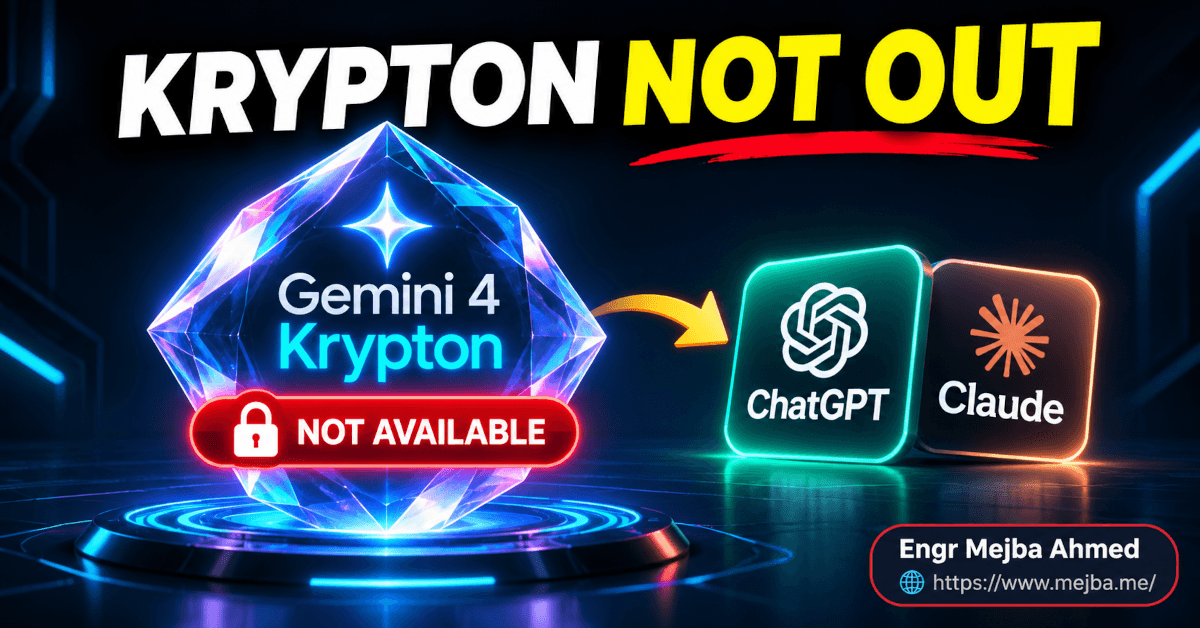
Gemini 4 Krypton is not a released model. As of November 15, 2026, Google hasn't announced it, it isn't on Google's Gemini API pricing page, and it has no published price, model ID or benchmark score. Everything you've seen about it comes from tester posts on X, starting around November 9. Three Gemini 4 models are real and callable today: Argon, Carbon and Hydrogen. And the headline claim that Krypton rivals Fable 5.2 while being cheaper looks like it was borrowed from Carbon, which really did launch at a fraction of Fable 5.2's price on November 10.
That's the answer. The rest of this post is how I got there, and what I'd do with it.
A video summary landed in my queue this weekend calling Krypton a cheap Fable 5.2 rival, alongside a list of Claude Code updates, a math breakthrough, an AI wallet, and a SpaceX catch "using AI-driven control systems." I checked each claim against its source. Of the nine or so claims, only two held up as stated: the Claude Code updates and ChatGPT Wallet. Most of the rest were real events with the wrong details attached, and Krypton itself has no official source at all.
Here's what I actually ran, so you know where my evidence stops. I pulled four Claude Code builds (one from npm, three already on my Mac) and diffed their strings to see how the new custom-theme API changed. Those results are mine. I didn't run Krypton, because nobody outside Google can. I also didn't run Gemini 4 Carbon, Claude Fable 5.2 or any GPT model for this post. Every number about them comes from a named source, and I say which in the sentence.
The Krypton story starts with a single tester's side-by-side, and that's where the trouble begins.
What Is Gemini 4 Krypton?
Gemini 4 Krypton is the reported codename for an unreleased Gemini 4 checkpoint that testers say they've seen in Google's internal or blind-arena testing. Google hasn't confirmed it exists. The name follows Google's chemical-element pattern for this generation: Argon, Carbon, Hydrogen.
Even the first sighting is disputed. Vendor blogs from kie.ai and TeamoRouter trace it to a November 9 X post by developer Chetaslua, who posted a side-by-side of something labelled "krypton-a" against Carbon and Argon and called it the first checkpoint. CellCog's timeline, by contrast, starts with leak accounts on November 13 and 14. I couldn't open the X posts myself (X returned a paywall to my fetch), so I'm relaying what those vendor blogs say the posts contain.
Here's the trail as those blogs report it:
| Date (2026) | Claim | Who | Status |
|---|---|---|---|
| Nov 9 | "krypton-a" side-by-side vs Carbon and Argon | Chetaslua on X, per kie.ai and TeamoRouter | Unverified |
| Nov 12 | Krypton spotted on Design Arena | Testers, per kie.ai | Unverified |
| Nov 13 | Checkpoint ID 01a1d60a-… observed |
@abhinavflac, per kie.ai and CellCog | Can't be checked |
| Nov 14 | Krypton is serving behind the gemini-4-hydrogen label on Arena |
Several accounts | Disputed, best-known poster retracted |
| Nov 14 | Krypton isn't on Arena at all | @lyraxana | No source given |
| Nov 25 / Dec 8 | Limited, then public release | Reddit post relayed secondhand | Rumor |
Look at the Nov 14 rows together. One group says Krypton is hiding behind the Hydrogen label. Another says it isn't on Arena at all. Google had shipped Hydrogen as a real product two days earlier. If a tester gets an impressive answer from a model labelled gemini-4-hydrogen, the boring explanation is that it's Hydrogen.
So if Krypton isn't callable, what is? That part has a clean answer, with official prices attached.
The Gemini 4 Models You Can Call This Week
Google has shipped three Gemini 4 models in five weeks. I took the prices from Google's own Gemini API pricing page (standard paid tier, per million tokens):
| Model | Released (2026) | Input | Output (incl. thinking) | Cached input | Notes |
|---|---|---|---|---|---|
| Gemini 4 Argon | GA Oct 13 | $2.00 → $4.00 on Dec 1 | $10.00 → $20.00 on Dec 1 | $0.10 → $0.20 | Long multi-step work |
| Gemini 4 Carbon | Announced Oct 28, open to paid users Nov 10 | $2.00 → $4.00 on Dec 1 | $10.00 → $20.00 on Dec 1 | $0.10 → $0.20 | Google's frontier model, 1M context |
| Gemini 4 Hydrogen | Nov 12 | $1.50 | $7.50 | $0.075 | Fast tier, also in Search and the free Gemini app |
| Gemini 4 Krypton | Not released | — | — | — | Not on Google's pricing page |
Two things in that table matter more than the model names.
The prices double on December 1. Argon and Carbon are on an introductory rate that ends November 30. If you benchmark Carbon this month and budget on today's numbers, your December bill will be twice your estimate for the same work. Hydrogen has no introductory window listed.
My own November roundup is now out of date. In the AI news roundup for November 2026, I wrote that Argon was the only Gemini 4 model you could call and that Hydrogen was an unconfirmed codename. Both were true on November 8. Neither is true now. Google's November 12 posts launched Hydrogen in the Gemini API, AI Studio, Android Studio, Antigravity and Google Search. Leak cycles move fast, and a codename can turn into a product in four days.
If you want the background on what Google promised for Gemini 4 back in May, my Google Gemini 4 deep dive covers the agentic pitch from before any of these shipped.
Here's where the "cheaper than Fable 5.2" line comes in, and why I think it got attached to the wrong element.
Where "Rivals Fable 5.2 for Less" Probably Came From
On November 10, VentureBeat ran a story with a headline that says it outright: Gemini 4 Carbon is publicly available "and it undercuts Claude Fable 5.2 and Opus 5.5 on API price." That's a Carbon story. Krypton isn't in it.
The numbers in that piece back the claim for Carbon:
- Price: Claude Fable 5.2 lists at $8 input and $40 output per million tokens, after Anthropic cut it from $10 and $50 at its November 9 launch. Carbon's intro price is a quarter of that, and its December price is half.
- Intelligence index: On Artificial Analysis's Intelligence Index as VentureBeat reported it, Fable 5.2 at max effort scores 65, Carbon at high scores 60, Opus 5.5 at max scores 59 and GPT-6 Astra at max scores 57. Carbon briefly held first place at its October debut, before Fable 5.2 arrived and Artificial Analysis rescored the field.
- Mixed benchmarks: Carbon led on Terminal-Bench 4.0 (65.2% vs Fable's best listed 61.6%) and Zapier's AutomationBench. Fable led on FrontierCode 2.0 (49.1% vs 40.6%) and Anthropic's FrontierSWE v2 (69.9% vs 61.2%).
So "a cheaper Gemini 4 model that competes with Fable 5.2" is a fair description of Carbon. My best guess is that the video blended the verified Carbon story with the Krypton hype from the same week. I can't prove that, but it's the only "cheaper than Fable" claim with a source behind it.
Cheaper per token isn't cheaper per task
Here's the part of the Carbon story most coverage skipped. VentureBeat also reported Artificial Analysis's cost to run its full index, per task, at standard rates:
| Model and effort | Index score | Cost per task |
|---|---|---|
| Claude Fable 5.2, medium | 56 | $3.80 |
| Gemini 4 Carbon, medium | 58 | $6.59 |
| GPT-6 Astra, max | 57 | $6.24 |
| Gemini 4 Carbon, high | 60 | $7.76 |
| Claude Fable 5.2, high | 62 | $9.08 |
| Claude Fable 5.2, max | 65 | $26.54 |
Read that again. Fable 5.2 lists at twice Carbon's standard price per token. At medium effort it still came in cheaper per task than Carbon at medium ($3.80 vs $6.59), because it used fewer tokens, though it also scored two points lower (56 vs 58). At high effort, Carbon is cheaper, but only by about $1.30 a task, and it scores two points lower.
That's why I don't trust any "cheaper" claim that only quotes a price sheet. What you pay is price times tokens, and the second number varies a lot between models.
That cost logic also tells you something about Krypton, using the one concrete claim testers made about it.
Is Gemini 4 Krypton Better Than Fable 5.2? What the Tester Posts Actually Show
Nobody has published a Krypton score on any benchmark, so the short answer is that nobody knows. Here's every claim I could find, and what each one can and can't tell you:
- Roughly twice the time and twice the code of Carbon on one identical prompt (Chetaslua, Nov 9, per kie.ai and TeamoRouter). This is the most concrete claim, and it measures length. TeamoRouter's write-up makes the same point: time and code length say nothing about correctness.
- The most diligent Google model the tester had tried (Chetaslua, as paraphrased by TeamoRouter). That's an impression.
- Best on lighting, smoke and water in a three-way visual test (@Adidotdev, per kie.ai). Another tester called the gain over Carbon slight.
- Demo timings: a sailing-ship scene in 22 minutes 20 seconds, an anime sequence in 39 minutes, a voxel sandbox in about ten minutes. Each comes from a single poster, with no prompt or output you can rerun.
- Roughly Opus 5.5 level, per several posters, with no score attached.
- A predicted 64 on the Artificial Analysis index. That's one person's forecast.
- A "$4/$20" price, which the poster said was a guess. It happens to match Carbon's December price, which tells you where the guess probably came from.
The video's description of Krypton building complex JavaScript simulations and 3D scenes "without external assets" fits these demos. Self-contained SVG, voxel and canvas scenes are what testers use to compare frontier models right now. But I can't tell you how good those outputs are, because I can't run the model. And neither can the person who made the video.
Run the cost math on the one number we have
Here's where the per-task logic pays off. If Krypton really writes about twice the output of Carbon on the same prompt, and if Google prices it at Carbon's December rate (both big ifs), your output bill roughly doubles even at the same per-token price.
I wrote a short calculator to make that concrete, using official list prices and an example task of 60K tokens in and 15K tokens out:
# Per-task cost from list prices (USD per 1M tokens), uncached input.
PRICES = {
    "Gemini 4 Hydrogen":            (1.50, 7.50),
    "Gemini 4 Carbon (to Nov 30)":  (2.00, 10.00),
    "Gemini 4 Carbon (from Dec 1)": (4.00, 20.00),
    "Claude Opus 5.5":              (4.00, 20.00),
    "Claude Fable 5.2":             (8.00, 40.00),
}

def task_cost(model: str, input_tokens: int, output_tokens: int) -> float:
    price_in, price_out = PRICES[model]
    return (input_tokens * price_in + output_tokens * price_out) / 1_000_000

IN, OUT = 60_000, 15_000  # example task, thinking tokens counted as output
for model in PRICES:
    print(f"{model:30s} ${task_cost(model, IN, OUT):.3f}")

# Same task if a model writes twice the output, at Carbon's Dec 1 price.
print(f"{'Carbon Dec 1 price, 2x output':30s} ${task_cost('Gemini 4 Carbon (from Dec 1)', IN, OUT * 2):.3f}")
Output, run with Python 3 on my Mac:
Gemini 4 Hydrogen              $0.203
Gemini 4 Carbon (to Nov 30)    $0.270
Gemini 4 Carbon (from Dec 1)   $0.540
Claude Opus 5.5                $0.540
Claude Fable 5.2               $1.080
Carbon Dec 1 price, 2x output  $0.840
The token counts are made up for illustration. The prices are not. Two things fall out of it.
First, from December 1, Carbon and Opus 5.5 cost exactly the same per token: $4 in, $20 out. "Gemini is cheaper than Claude" stops being true at the price-sheet level for that pair. The real comparison becomes how many tokens each one burns on your work.
Second, a model that writes twice as much at Carbon's price lands at $0.84 on this example. That's most of the way to Fable 5.2's $1.08 before you've measured whether the extra output is any better. "Diligent" costs money.
Swap in token counts from your own logs. That one change makes this more useful than any leaked chart.
So should you wait for Krypton, or pick something today? Anthropic published its own answer to that question the same week, and the video only got half of it right.
Anthropic's Model Advice Says Something Different From the Video
The summary claimed Anthropic's guidance shows "Opus 5.5 at medium reasoning effort outperforms or matches pricier models like Fable 5.2." The guide doesn't say that.
The post is "Which Claude model should you build with?" by Addy Osmani, published on claude.dev on November 9. Its actual advice:
- Start most work on Opus 5.5 at its default effort, medium. It's the default model in Claude Code. At $4/$20 it costs half of Fable 5.2 per token.
- Move up to Fable 5.2 for the hardest technical projects, long unattended runs, or when Opus 5.5 at high effort still falls short.
- Change effort before you change models. By Anthropic's own SWE-bench Pro runs, Opus 5.5 at medium scores about 2.5 points below high at about 70% of the cost.
And here's the detail that cuts against the video. On FrontierCode 2.0, the guide reports Fable 5.2 at high effort scoring 45.3%, against Opus 5.5 at max scoring 45.5%, at roughly half the cost per task. That's why the guide says to test Fable 5.2 before you raise Opus 5.5 past high on a hard task.
So the real rule isn't "the cheap model wins." It's "start cheap, and when you need more, a bigger model at lower effort can beat a smaller model at maximum effort." That's the same pattern as Fable medium beating Carbon medium on cost per task in the table above. All of these numbers are Anthropic's own runs, and nobody has reproduced them independently yet.
I've written about this trade-off at length already, so I won't repeat it. My guide to Claude Code effort levels covers what each level buys, and my Claude Opus 5.5 launch breakdown has the pricing and breaking API changes.
Now for the practical part: what I'd pick this week.
What I'd Use Instead of Waiting for Gemini 4 Krypton
This is my opinion, built on the prices and published benchmarks above. I haven't run these models myself, so treat it as a starting point for your own evals:
| Your situation | My pick this week | Why |
|---|---|---|
| Everyday coding in Claude Code | Opus 5.5 at medium | Anthropic's default, half Fable's price per token |
| Hard refactor, migration, long unattended run | Fable 5.2 at medium or high, before Opus at max | FrontierCode 2.0: same score at roughly half the cost |
| Terminal-heavy or automation agents, cost-sensitive | Trial Gemini 4 Carbon before Nov 30 | Led Terminal-Bench 4.0 and AutomationBench, and it's at intro pricing |
| High-volume, fast, everyday tasks | Gemini 4 Hydrogen | $1.50/$7.50, no intro window to expire |
| "I'll wait for Krypton" | Don't block on it | No date, no price, no model ID |
The one action with a deadline: if you want to evaluate Carbon, do it before November 30, and budget at the December 1 price. Benchmark at $2/$10, plan at $4/$20.
The other thing I'd do is build so that switching models is cheap. If Krypton ships on the rumored November 25 date, or in December, or never, a pipeline with the model name in one config value and a per-task cost log on every call can absorb any of those outcomes in an afternoon. A pipeline with "gemini-4-carbon" hardcoded in eleven places can't.
If you'd rather have someone set up that kind of model-agnostic agent pipeline, with cost logging built in from day one, I take on exactly these builds. You can see what I've shipped at fiverr.com/s/EgxYmWD.
That's the Gemini side. The video also bundled a set of Claude Code updates, and those I could check on my own machine.
The Claude Code Theme API Changed the Day Before It Was Announced
The summary listed "custom themes, multitasking with parallel threads, and thread reminders." All three are real. They came in two separate November 13 announcements from Anthropic's @ClaudeDevs account, and they're easy to mix up:
- Custom themes for the Claude Code desktop app, built with mods: recolor the interface and add an animated background. Anthropic ships a
theme-examplesplugin to start from, and you can ask Claude to design one for you. AlphaSignal reports it needs Claude Code 2.1.319 or later, and that themes work in local desktop sessions today, with cloud sessions "coming soon." - An update to Projects in Claude Code. In a project, a coordinator runs your tasks across parallel threads. Each thread is a full cloud session with its own copy of the repo and its own Git branch, as third-party write-ups describe it. Anthropic says the coordinator is now more proactive and posts status updates on its own. You can set a reminder on any thread, and
/btwand/forknow work inside projects.
I didn't test Projects. It's a waitlisted beta on the web, desktop and mobile apps, and the terminal CLI doesn't have it yet. What I could test is the theme API, because it ships inside the Claude Code binary.
What I found in the binaries
I checked four builds: 2.1.319 (pulled from npm), plus 2.1.322, 2.1.323 and 2.1.325, which were already on my Mac from auto-updates. Publish times come from npm:
npm view @anthropic-ai/claude-code time --json | grep -E '"2\.1\.3(19|2[2-5])"'
#  "2.1.319": "2026-11-06T00:58:56.366Z",
#  "2.1.322": "2026-11-10T01:58:41.811Z",
#  "2.1.323": "2026-11-12T20:29:28.626Z",
#  "2.1.324": "2026-11-13T18:42:36.300Z",
#  "2.1.325": "2026-11-13T20:07:25.823Z",

npm pack @anthropic-ai/claude-code-darwin-arm64@2.1.319 && tar xzf anthropic-ai-claude-code-darwin-arm64-2.1.319.tgz
strings -n 6 package/claude > s_2.1.319.txt
strings -n 6 ~/.local/share/claude/versions/2.1.325 > s_2.1.325.txt
grep -ac 'overrideColorScheme' s_2.1.319.txt s_2.1.325.txt
| String in the binary | 2.1.319 (Nov 6) | 2.1.322 (Nov 10) | 2.1.323 (Nov 12) | 2.1.325 (Nov 13) |
|---|---|---|---|---|
theme.set (count) |
10 | 10 | 16 | 18 |
Old help text: backdrop: { id, glass?, colorScheme? } |
3 | 2 | 0 | 0 |
overrideColorScheme |
0 | 0 | 9 | 9 |
examples/look.ts |
0 | 0 | 3 | 3 |
(SHA-256 prefixes for the darwin-arm64 binaries, so you can confirm you have the same files: 2.1.319 1f53587e92dee8e0, 2.1.322 a9d237949db816a0, 2.1.323 5432918d904a9b6a, 2.1.325 84590fefe6338be9. Other platforms hash differently.)
AlphaSignal's "2.1.319 or later" checks out: $.theme.set is already in 2.1.319. But the API changed shape in 2.1.323, published November 12, the day before the announcement.
In 2.1.319, the help string reads:
theme.set takes backdrop: { id, glass?, colorScheme? }; $.theme.clear() clears the theme
In 2.1.322, colors were added to that same signature:
theme.set takes backdrop: { id, glass?, colorScheme? }, colors, or both; $.theme.clear() clears the theme
From 2.1.323 on, it reads:
$.theme.set({ colors, backdrop, overrideColorScheme })names the whole theme, so a later set replaces it. Send everything in one call, fromsession.start.$.theme.clear()clears any mod's theme, so call it only when the person asks.
So the API went through three shapes in a week, and the last change brought two practical differences. The color-scheme setting moved out of backdrop and became a top-level overrideColorScheme. And a second set call now replaces the whole theme instead of adding to it. The new build also ships a reference file and a rule for single-mode looks. The binary says to give a half with only: 'dark' for a theme made for one mode.
If you followed a tutorial or a screenshot from the first days of the API, written against 2.1.319 to 2.1.322, a theme that sets colorScheme inside backdrop, or calls set twice for colors and backdrop separately, is written against the old shape. Run claude --version, and if you're on 2.1.323 or later, start from the bundled examples/look.ts instead.
What this doesn't show: the strings tell me the API shape, not how the desktop app renders it, and I haven't built a theme against it. If you've used Claude Code Desktop's nested sessions and Mods, themes are one more thing a mod can do.
The Projects cost catch
Look past the coordinator. Every thread in a project draws on the same plan limits as any Claude Code session, so five parallel threads use your allowance about five times as fast as one. According to Anthropic's docs as the DEV Community write-up quotes them, new projects default to Opus, with worker threads at high effort and the coordinator at low. That's a sensible default for quality. On a Pro plan, it's also how you hit your limit by lunchtime. If you're rationing usage, lower the worker effort before you raise the thread count.
That covers the developer tools. The rest of the video went well beyond them, and the details got shakier the further it went.
The Rest of the Video's Claims, Checked
Each of these was a real event. Most of them carried a detail the sources don't support.
Google's math results: formalized isn't the same as resolved. The summary says Gemini systems "autonomously formalized and resolved long-standing mathematical problems." Google Research's November 13 post, by Vahab Mirrokni, describes three different things:
- Birkhoff conjecture (open since 1927): Google says /teamwork-LEAP generated the first formalization, meaning a precise statement of the problem in Lean. The post doesn't claim a proof.
- Weil conjectures: an end-to-end machine-checked formalization of about 1.8 million lines of Lean, across 28,800 subagent invocations, produced "fully autonomously" by the LEAP framework paired with Gemini 4 Argon.
- Courtade–Kumar conjecture (2013): actually proved, in full generality. A team at CUHK reduced the problem to a 14-variable optimization, Gemini 4 Argon and earlier models developed most of the new analytical bounds, and the full proof was formalized in 50 million lines of Lean.
Google also says the work was done with human experts, and that humans must confirm a formal statement matches the original problem. That last point matters: Lean checks the proof's logic. It can't tell you whether you formalized the right question. I made the same distinction about OpenAI's results in what OpenAI Astra's math proofs actually prove, and it applies here too.
ChatGPT Wallet: real, and narrower than it sounds. OpenAI launched it on November 13 for its "dots" agents. It starts with US ChatGPT Pro subscribers aged 18 or older with eligible US-issued credit cards from Visa, Mastercard or American Express. Purchases use a payment token, so neither the agent nor the merchant sees your real card number. You approve each purchase with Face ID or a fingerprint after reviewing the items, the total and the card, and you keep your card rewards and dispute rights. Hands-free buying with spending limits is a stated plan, with no date. OpenAI also warns that merchant sites may block shopping agents or flag Wallet purchases as fraud. If you're building the merchant side of this, my teardown of Anthropic's commerce agent architecture covers the patterns.
Google's agent payments: nothing new this week that I could find. Google's Agent Payments Protocol (AP2) dates to September 2025. Universal Cart and agent purchases with spending caps were announced at I/O in May 2026, with reported US rollouts since. I found no Google agent-payments launch in November, so I'd treat the video's pairing of Google with ChatGPT Wallet as background.
GPT-6.2 Astra: still unannounced. The summary says it "delivers stunning generative visuals." OpenAI hasn't released or announced a GPT-6.2 Astra. The name comes from Codex usage screenshots and a model string seen in early November. A CellCog check of OpenRouter's catalog late on November 13 found nothing newer than GPT-6 Astra, which launched September 3. At least one widely shared Astra demo was walked back: per Kingy AI's tracker, the poster said an editing step had enhanced the visuals beyond the model's original output.
"Mammoth": it's Mammouth AI, and the integrations aren't new. Mammouth AI, a French multi-model chat platform, added pre-built connectors for Microsoft 365, GitHub, Notion and Atlassian on August 20, 2026, per its own release notes. Its latest release notes, from November 9, don't mention connectors.
SpaceX: a real first, with the wrong details attached. SpaceX's Flight 15 launched on Friday, November 13, and on November 14 the tower's arms caught Ship 42, the Starship upper stage, after about 22.5 hours and 14 orbits. Space.com, Teslarati and Interesting Engineering all describe it as the first time an upper stage was caught after an orbital return. The Super Heavy booster was not caught: Teslarati reports it aborted for a guidance issue it detected and came down in the Gulf of Mexico. So "the full Starship" is wrong. I found no source saying AI controlled the catch. Teslarati's coverage mentions flight software only for a booster engine-cutoff change. Grok's documented role at SpaceX is spotting foreign-object debris in borescope inspection footage, which has nothing to do with flying the ship. It's a remarkable engineering result. Crediting it to AI isn't supported.
What Would Change My Mind
Three things, specifically.
If Google publishes a Krypton model ID and price, everything in the Krypton sections becomes a pricing exercise, and the calculator above is ready for it. If the rumored November 25 date holds, the next step is testing it against Carbon and Fable 5.2 on real tasks, not on demo scenes.
If someone publishes a reproducible Krypton output (prompt, raw output, timing, no editing), the "2x code" claim becomes something you can measure. Until then it's one person's description of one prompt.
And if Artificial Analysis reruns the field after Carbon's December price change, the cost-per-task table shifts. Carbon's per-task costs above are already at standard rates, so I'd expect the ranking to hold. I'd still want to see it.
The video called Krypton a cheaper rival to Fable 5.2. The cheaper rival exists. It's called Carbon, it launched on November 10, and its price doubles on December 1. Krypton is a name in some X posts, with a "2x the code" observation that, if it holds, points to a bigger bill per task.
Here's what to do before November 30: pull the token counts from your last 50 agent runs, drop them into the calculator, and compare Carbon, Opus 5.5 and Fable 5.2 on your own numbers. That will tell you more than any leaked side-by-side.
FAQ
Frequently Asked Questions
Everything you need to know about this topic
No. As of November 15, 2026, Google hasn't announced Gemini 4 Krypton, and it isn't listed on Google's Gemini API pricing page. Every claim about it comes from tester posts on X since around November 9. The leak timeline section above lists each claim and its status.
Google hasn't given one. A Reddit post, relayed secondhand on X, claims a limited release on November 25 and public availability on December 8, 2026. Neither date has any official backing, so don't plan around them.
Nobody knows. The "$4/$20 per million tokens" figure circulating online was labelled a guess by the person who posted it, and it matches Gemini 4 Carbon's December 1 price. Carbon is $2/$10 through November 30, then $4/$20.
Per token, yes: Carbon is $2/$10 now and $4/$20 from December 1, against Fable 5.2's $8/$40. Per task, it depends on effort level. Artificial Analysis measured Fable 5.2 at medium cheaper per task than Carbon at medium. See the cost-per-task table above.
Three: Gemini 4 Argon (generally available since October 13), Gemini 4 Carbon (open to paid users since November 10) and Gemini 4 Hydrogen (released November 12, the cheapest at $1.50/$7.50 per million tokens). All three are in the Gemini API.
Let's Work Together
Looking to build AI systems, automate workflows, or scale your tech infrastructure? I'd love to help.
- Fiverr (custom builds & integrations): fiverr.com/s/EgxYmWD
- Portfolio: mejba.me
- Ramlit Limited (enterprise solutions): ramlit.com
- ColorPark (design & branding): colorpark.io
- xCyberSecurity (security services): xcybersecurity.io