"Claude Code is for writing code."
I believed that for months. I'd fire it up when I needed to debug something, write a function, or scaffold a new project. Then I'd close it and go back to my regular tools for everything else.
I was completely missing the point.
The Mental Model That Held Me Back
Here's the thing about Claude Code that nobody tells you upfront: the name is misleading. It's not a coding tool. It's an agentic loop system that happens to be really good at coding. But that's like saying your car is a cup holder that happens to have wheels.
The breakthrough came when I stopped asking "How can Claude Code help me code?" and started asking "What can an autonomous agent with file access, web search, and tool execution actually do?"
That question changed everything.
What I Built Instead of Code
I spent the last few months building something I never expected: a multi-agent workflow system that handles research, content curation, document generation, and even creative tasks. No traditional coding required.
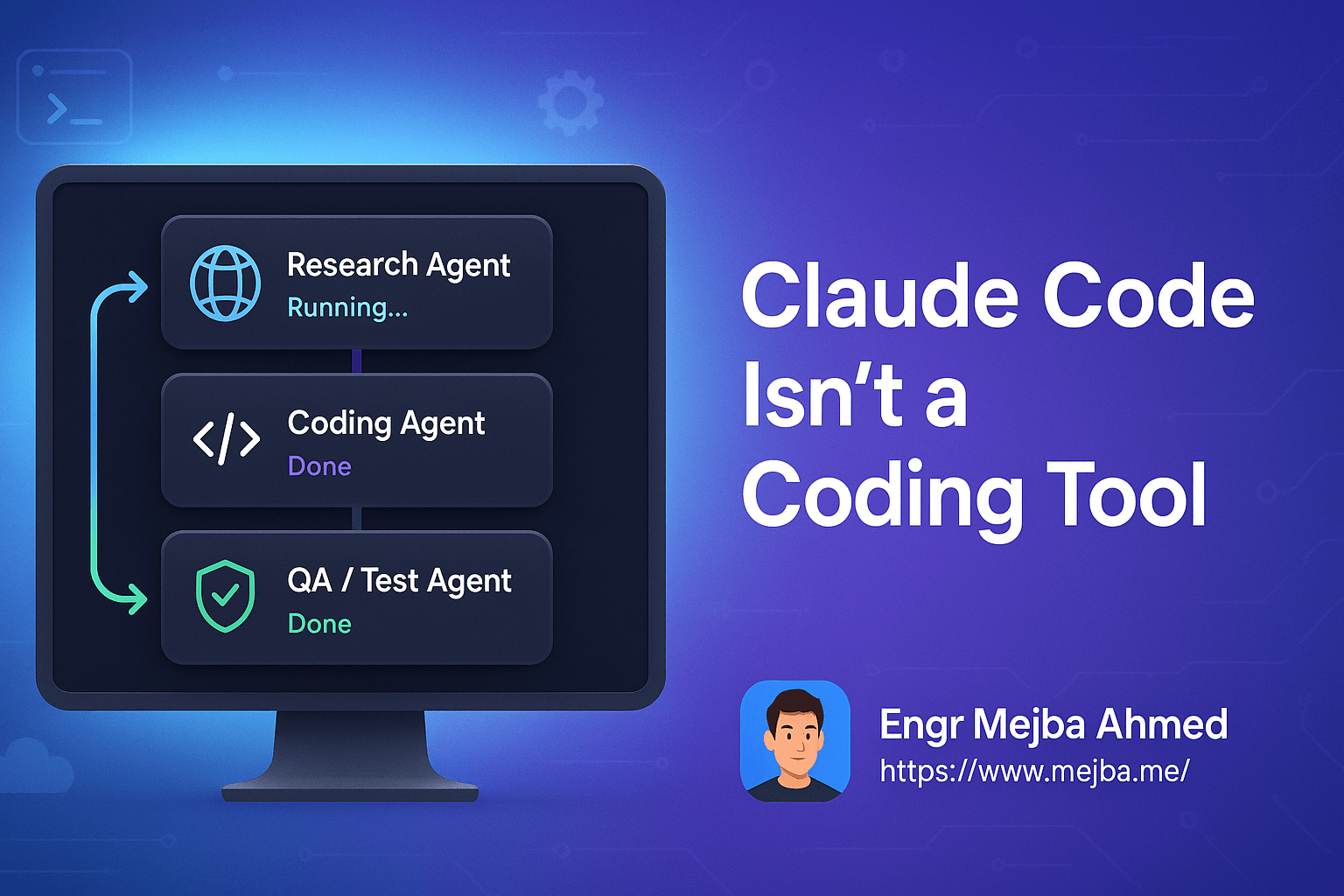
The system is built around a simple concept: modular agents that work sequentially on data. Research notes, meeting minutes, raw files, whatever. Each agent has one job, does it well, and passes the output to the next agent in the chain.
Here's what a typical workflow looks like:
Research Agent → Performs deep web research on a topic, compiling text and citations Image Curator Agent → Validates and sources relevant images HTML Builder Agent → Generates a navigable web page with all the content
I ran this against video game history research. The system gathered information about classic arcade games, found cabinet images, pulled gameplay costs and production numbers, then assembled everything into an interactive HTML page. Complete with citations and navigable sections.
Zero code written. I just defined what each agent should do and let them work.
The Secret Sauce: Progressive Disclosure
The real magic isn't in the agents themselves—it's in how you manage context.
Claude Code, like any LLM-based system, has a context window. Throw everything at it and you'll hit walls fast. The solution is progressive disclosure: a lightweight instructions file that pulls in detailed agent definitions only when needed.
Think of it like lazy loading for AI workflows. Your main instructions file is a table of contents. It knows what agents exist and what they do at a high level. When you actually invoke an agent, that's when the full agent definition gets loaded into context.
This approach scales. I've added agents for Instagram post generation, holiday jingle creation (yes, really), and batch image transformation. Each one is self-contained. The instructions file just knows they exist.
A Non-Obvious Use Case: Holiday Jingles
I wanted to test how far I could push this beyond traditional productivity tasks. So I built a jingle workflow.
The agent generates holiday-themed audio content and integrates it directly into an application by creating new files, animations, and themes. All from a simple prompt about what holiday I'm targeting.
Would I ship this to production? Absolutely not. But the fact that it works at all demonstrates something important: Claude Code's architecture doesn't care whether you're writing TypeScript or composing seasonal music. It's the same agentic loop either way.
How This Compares to Anthropic's Skills
Anthropic released their own solution for this: Skills. They serve a similar purpose but with more elegant context management and broader integration across Claude AI, the API, and the desktop app.
Skills are probably the better long-term approach. They're shareable, have marketplace support, and Anthropic is actively developing them.
But here's my honest take: Skills are probabilistic. They don't always get invoked reliably without explicit instructions. My manual agent system gives me explicit control. I tell it which agent to run and it runs that agent. No guessing, no hoping the LLM understands what I want.
The good news? Converting a manual agent to a Skill is straightforward. Claude can actually do the conversion for you. So you're not locked into either approach.
One caution on Skills marketplaces: be careful with third-party code. Unvetted agent definitions can execute arbitrary commands. Trust the source before you install.
Setting This Up Yourself
The system lives in a repository called Open Agent System. Here's the structure:
├── instructions.md      # The orchestrator
├── agents/              # Individual agent definitions
├── inputs/              # Source data
├── outputs/             # Generated content
└── tools/               # Shared utilities
The instructions.md file describes every available agent and how to invoke them. Each agent file in the agents/ directory contains the full prompt and tool permissions for that specific workflow.
Adding a new agent is three steps:
- Create an agent definition file
- Update
instructions.mdto include it - Run it
That's it. No build process, no deployment, no dependencies.
A Quick Win: Batch Image Transformation
Want to see this in action without building a whole research pipeline?
I created a simple image transformation agent that applies effects to batches of images. Point it at a folder of photos, tell it to apply a Polaroid effect, and walk away. It processes each image, applies the transformation, and saves the results.
The entire agent definition is maybe fifty lines of instructions. The actual image processing uses built-in tools. I just defined what "Polaroid effect" means in natural language and let Claude Code figure out the implementation.
This is what I mean by "changed everything." Tasks that would have required writing a Python script, dealing with PIL or ImageMagick, handling file I/O—all of that collapses into a natural language description of what I want.
The Bigger Picture
Claude Code isn't competing with VS Code extensions or IDE plugins. It's competing with automation platforms, workflow builders, and scripting languages.
The developers who see Claude Code as a coding assistant are missing the forest for the trees. Yes, it writes great code. But the architecture that makes it good at coding—persistent sessions, file system access, tool execution, web search—makes it good at any task that benefits from autonomous, iterative work.
Research papers. Content pipelines. Data transformation. Document generation. Media processing. If you can describe it as a series of steps with clear inputs and outputs, you can build an agent for it.
What I'm Building Next
The workflow that excites me most right now is automated documentation. Not just generating docs from code, but maintaining a living research repository that updates itself based on new information.
Imagine pointing an agent at your industry's news sources, having it synthesize relevant updates, and automatically integrating them into your knowledge base. Weekly. Without intervention.
That's where this is heading. Not code generation—knowledge automation.
Try It Yourself
The Open Agent System repository is public: github.com/bladnman/open-agent-system
Clone it. Open it in Claude Code. Run /agents to see what's available. Pick something that sounds interesting and watch it work.
Then build your own agent. Something specific to your workflow. Something you've been doing manually that you've always wished you could automate.
You don't need to write a single line of code to do it. You just need to describe what you want clearly enough for an autonomous agent to execute.
That's the shift. Claude Code isn't about coding. It's about describing work in a way that machines can execute autonomously.
Once you internalize that, you'll find uses everywhere.
Making the Mental Shift
Claude Code multi-agent productivity starts when you stop treating it as a coding tool and start treating it as a workforce — delegate outcomes, not keystrokes. My the workforce guide and parallel task management go deeper.
If you want a multi-agent system fitted to your day, that's work I take on through Ramlit.