

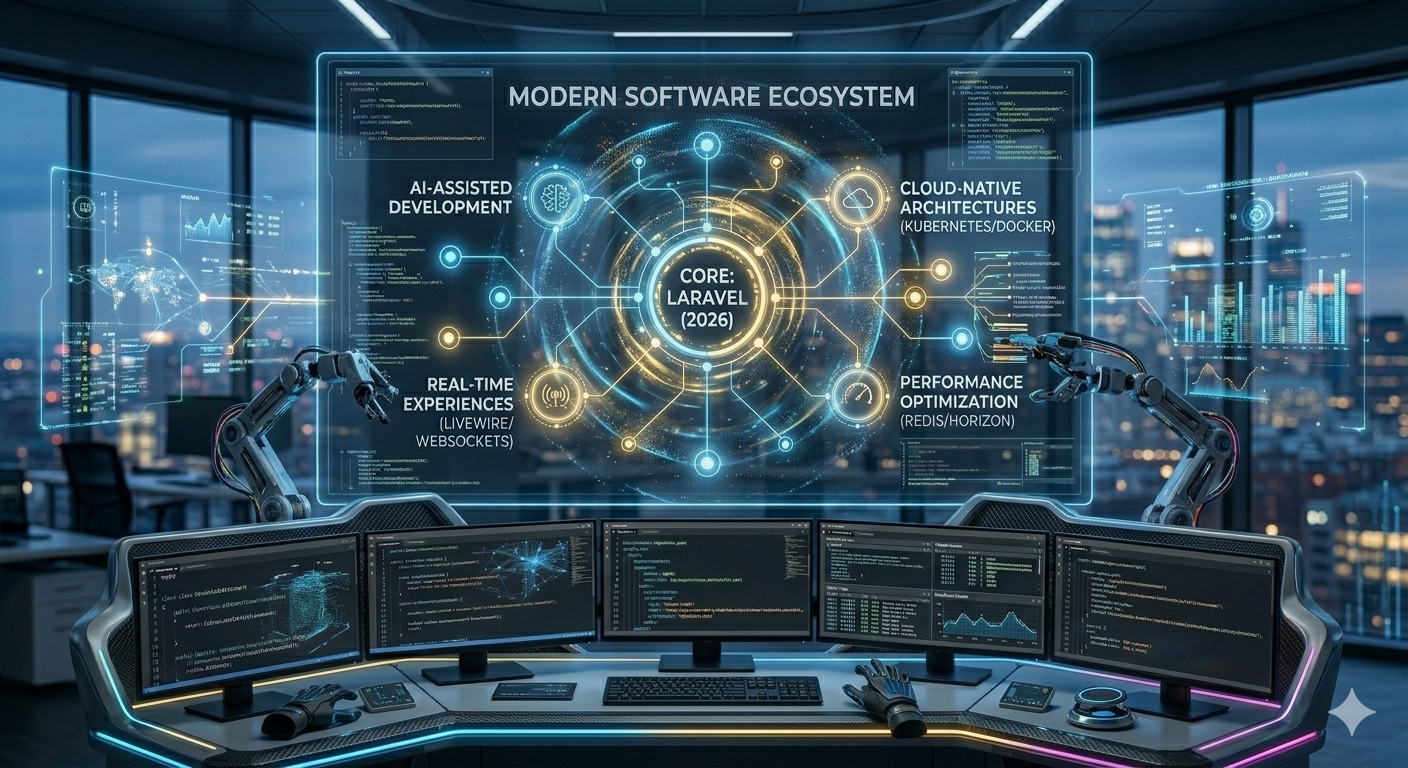
After more than a decade of building and scaling applications, I’ve learned that technology is never static. It evolves disrupts and redefines the way we think about software. Each era brings its own turning point, and 2026 is one of those defining moments.
Laravel, once considered a simple PHP framework, has now matured into a strategic enabler for intelligent, cloud-native, and enterprise-ready solutions. Today, it’s no longer just about writing code. It’s about architecting systems that are scalable, resilient, and future-proof.
AI-Assisted Development: Beyond Automation
Artificial Intelligence is no longer a buzzword—it’s a practical tool embedded into everyday workflows.
- Content Generation: Developers are integrating AI APIs to auto-generate product descriptions, blog posts, and even documentation. This reduces repetitive work and ensures consistency.
- Testing & Debugging: AI-driven test case generation and error detection are accelerating QA cycles. Instead of manually writing hundreds of unit tests, AI can propose scenarios based on code analysis.
- Learning Curve Reduction: Junior developers can now rely on AI copilots to explain complex code snippets, making onboarding faster and smoother.
Learning Point: AI is not replacing developers—it’s augmenting them. The real skill lies in knowing where to integrate AI responsibly without compromising creativity or security.
Cloud-Native Architectures: From Monoliths to Microservices
The industry has decisively shifted from monolithic applications to cloud-native microservices.
-
Containerization: Docker has become the default for packaging applications, ensuring consistency across environments.
-
Orchestration: Kubernetes is now the backbone of scalable deployments, enabling auto-scaling, load balancing, and fault tolerance.
-
Serverless Functions: Laravel developers are experimenting with serverless platforms (AWS Lambda, Azure Functions) to offload specific tasks like image processing or notifications.
Learning Point: Cloud-native design forces developers to think in terms of resilience and scalability. It’s not just about writing code—it’s about designing systems that survive failure gracefully.
Real-Time Experiences: Meeting User Expectations
Modern users expect instant feedback. Waiting for page reloads feels archaic.
- Laravel Livewire & Inertia.js: These tools bridge the gap between backend logic and frontend interactivity, enabling real-time updates without complex JavaScript frameworks.
- WebSockets: Real-time chat, notifications, and collaborative editing are now standard features in SaaS platforms.
- Streaming APIs: Developers are integrating live data streams (stock prices, IoT sensors, social feeds) directly into applications.
Learning Point: Real-time experiences are not just “nice-to-have”—they are user expectations. Ignoring them risks losing engagement.
Performance Optimization: Scaling Without Compromise
Performance is the silent killer of good applications. A system that works for 100 users may collapse under 10,000.
- Caching Strategies: Redis and advanced caching layers are now essential for reducing database load.
- Queues & Workers: Laravel Horizon provides visibility into background jobs, ensuring tasks like email sending or report generation don’t block user interactions.
- Database Optimization: Proper indexing, foreign key constraints, and optimized migrations prevent bottlenecks in production.
Learning Point: Performance optimization is not a one-time task—it’s a continuous discipline. Every decision, from schema design to API response handling, impacts scalability.
Enterprise Adoption: Laravel’s Maturity
Laravel has transitioned from being a “startup framework” to powering enterprise-grade SaaS platforms.
- Security: Role-based authorization, CSRF protection, and encrypted storage are now baseline requirements.
- Compliance: Enterprises demand GDPR, HIPAA, and SOC2 compliance—Laravel’s ecosystem supports these through packages and integrations.
- Integration: Laravel is increasingly used as the backend for mobile apps, IoT devices, and AI-driven platforms.
Learning Point: Laravel’s maturity means developers must think beyond CRUD. They must design systems that meet enterprise standards of reliability, compliance, and integration.
Professional Perspective: Lessons from the Field
In my own projects, I’ve seen how combining:
- Role-based authorization (admin, user, manager),
- Optimized migrations with clean foreign keys,
- AI-driven features like auto-generated product descriptions can elevate Laravel from a framework into a true business enabler. These aren’t just technical upgrades—they are strategic decisions that impact scalability, security, and user trust.
The Future: Intersection of Frameworks, AI, and Cloud
The next decade will be defined by convergence: Frameworks like Laravel providing structure. AI offering intelligence and automation. Cloud-native design ensuring scalability and resilience.
As engineers, our responsibility is not just to adopt tools. But to lead with vision, clarity, and impact.
The future of development lies at the intersection of frameworks, AI, and cloud-native design. Our role as engineers is to look beyond syntax and frameworks, to design systems that endure, scale, and inspire trust. The tools will keep evolving—but leadership, clarity, and vision will always remain timeless.
