
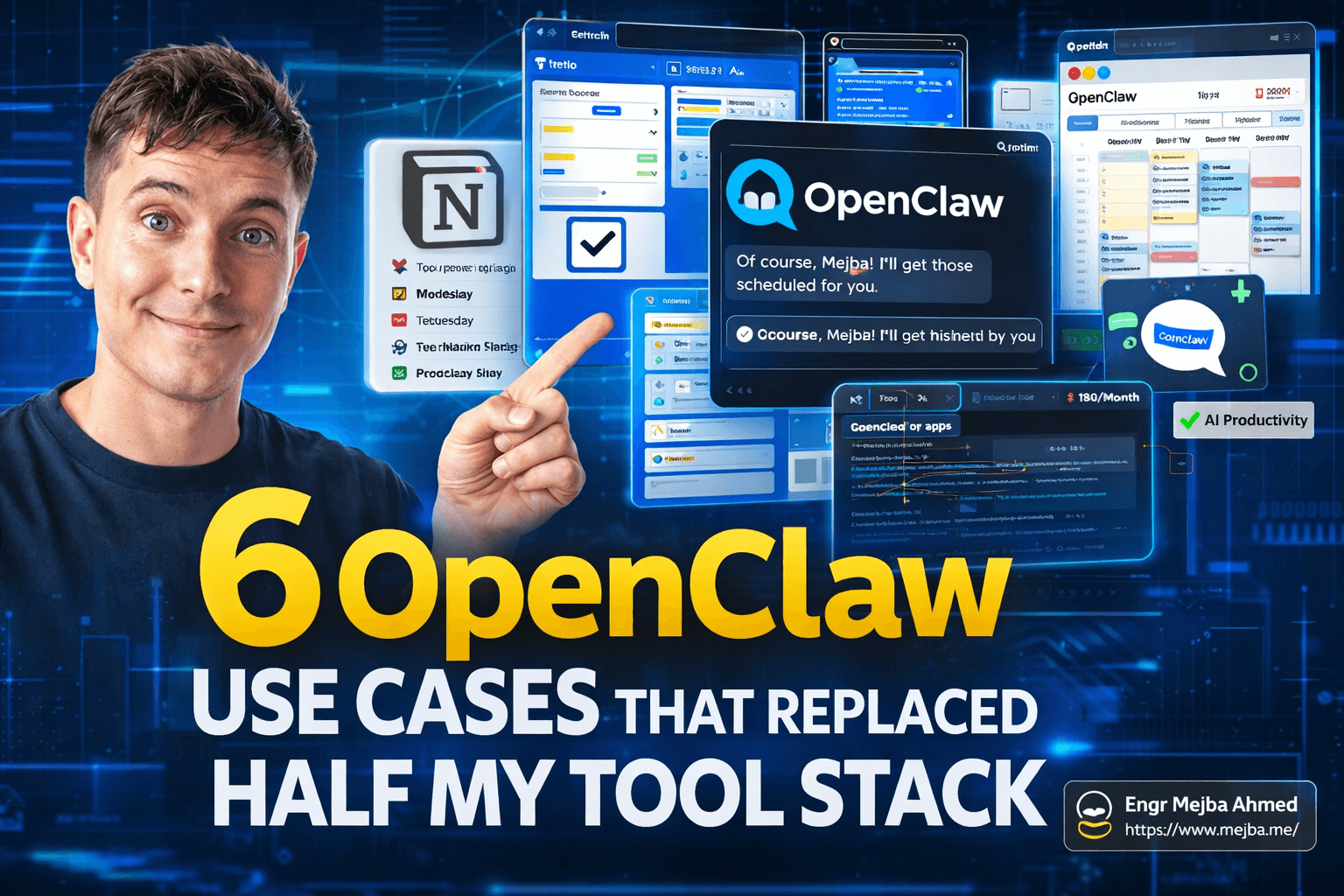
6 OpenClaw Use Cases That Replaced Half My Tool Stack
I have a confession. At one point last year, I was paying for seventeen different productivity subscriptions. Notion for notes. Google Calendar for scheduling. Trello for task management. Three different content planning tools. A research aggregator. A bookmark manager. Two separate note-taking apps because — honestly — I couldn't commit to one.
The total monthly bill was somewhere north of $180. And here's the embarrassing part: I was still losing ideas. Still forgetting tasks. Still spending my mornings manually stitching together information from six different dashboards before I could actually start working.
Then a friend sent me a link to OpenClaw with a one-line message: "Just text it like you'd text me." I almost ignored it. Another AI tool, another setup process, another thing to learn. But that "text it" part stuck with me. No new interface to learn? No dashboard to configure? Just... text?
I set it up on a Saturday afternoon. By Monday morning, I'd cancelled four subscriptions. By the end of the month, I'd cancelled nine more. And my actual productivity — not the feeling of being productive, but the measurable output — went up in ways I can track.
What I'm about to walk you through isn't theoretical. These are six specific ways I'm using OpenClaw right now, today, in my actual workflow. Some of them saved me time. A couple of them genuinely changed how I think about what an AI assistant can do. And one of them — the content factory setup — is so absurdly powerful that I'm still not sure most people realize what's possible.
But before I get into the specific use cases, you need to understand what makes OpenClaw different from every other AI tool cluttering up your browser tabs.
Why OpenClaw Clicked When Nothing Else Did
I've tested more AI productivity tools than I care to admit. Most of them share the same fundamental problem: they add complexity while promising to reduce it. You sign up for an AI assistant and immediately get hit with a dashboard, a settings panel, an API configuration page, an integration wizard, and a tutorial video series that's longer than most Netflix seasons.
OpenClaw does something radical. It strips all of that away and gives you a text interface. Telegram, Discord, iMessage, SMS — pick your poison. You talk to it the same way you'd message a colleague. No special syntax. No commands to memorize. No interface to navigate.
That sounds like a small thing. It's not. The friction difference between "open an app, find the right section, click the right button, fill in the right fields" and "send a text message" is enormous. It's the difference between a tool you intend to use and a tool you actually use. Every day. Without thinking about it.
The other thing that sets OpenClaw apart — and this took me a few days to fully grasp — is that it has persistent memory and internet access baked in. You're not talking to a stateless chatbot that forgets everything between sessions. You're talking to an agent that remembers what you told it last Tuesday, can research things on the internet while you sleep, and can execute multi-step tasks autonomously without you babysitting the process.
That combination — simple text interface, persistent memory, internet access, autonomous execution — is what makes the six use cases I'm about to show you actually work in practice rather than just looking good in a demo.
Here's the first one, and honestly, it's the foundation everything else builds on.
Use Case 1: Building a Second Brain That Actually Works
I've tried building a "second brain" at least five times. Notion databases with elaborate tagging systems. Apple Notes with folders and subfolders. Obsidian with bidirectional links. Every time, the system worked beautifully for about two weeks, then slowly collapsed under the weight of its own organizational structure.
The problem was never the tool. The problem was me. I'd have an idea in the shower and think "I should save that." Then I'd think about which app to open, which folder to put it in, what tags to assign, and by the time I'd made those decisions, I'd either forgotten the idea or decided it wasn't worth the effort.
OpenClaw solved this by making the capture step so trivially easy that there's no friction to overcome. I text it. That's it. "Hey, interesting article about distributed caching patterns — save this link." Done. "Remind me that the client mentioned wanting a dark mode option in the Q3 planning call." Done. "Book recommendation from Podcast X — Designing Data-Intensive Applications by Martin Klepperman." Done.
No folders. No tags. No organizational decisions at the point of capture. OpenClaw's memory system handles the storage, and when I need to find something, I just ask: "What was that book someone recommended about data systems?" It knows. It remembers context, timing, and even the source of where I captured the information.
Setting this up took me exactly one prompt. I told OpenClaw: "Act as my second brain. Whenever I send you information — ideas, links, notes, recommendations, random thoughts — store them in your memory. When I ask you to recall something, search through everything I've ever sent you and find the most relevant match."
That was it. No configuration. No database schema. No integration setup. One message and I had a second brain system that's been running flawlessly for months.
Pro tip: I added a follow-up instruction: "Every Sunday at 7 PM, send me a summary of the most interesting things I saved this week that I haven't acted on yet." This weekly review surfaces ideas I'd otherwise forget — and it's caught at least three genuinely good project ideas that would have disappeared into the void.
The second brain is foundational because everything else I'm about to show you builds on that memory layer. OpenClaw's ability to remember context across conversations is what makes the next five use cases possible.
And the next one? It transformed my mornings completely.
Use Case 2: A Custom Morning Brief That Does My Research for Me
I used to start every morning the same way. Open Twitter — sorry, X — and scroll for twenty minutes looking for AI news. Check three newsletters. Skim Hacker News. Open my task manager. Try to remember what I was working on yesterday. By the time I'd assembled a picture of what was happening in my industry and what I needed to do today, forty-five minutes had vanished.
Now I wake up to a Telegram message from OpenClaw. Every morning at 8:00 AM, it sends me a custom briefing that contains:
The latest AI developments — not a generic news dump, but stories specifically filtered for topics I care about. Model releases, hardware announcements, agentic framework updates, and anything related to my active projects.
Content ideas — based on trending discussions in my niche, OpenClaw suggests two or three potential blog post or video topics. Not just headlines — it generates a rough outline and even a draft opening hook for each one.
My task list — pulled from everything I've told it about ongoing projects, deadlines, and commitments. Prioritized by urgency and aligned with my weekly goals.
Recommended AI tasks — and this is the part that blew my mind the first time I saw it. OpenClaw proactively suggests tasks it can handle autonomously. "I noticed you mentioned wanting competitor analysis on X. Want me to research that today?" or "Based on your content calendar, you need a newsletter draft by Thursday. I can start a first draft now."
The magic is that OpenClaw doesn't just compile this brief in the morning. It researches overnight. While I'm sleeping, it's scanning news sources, checking trending topics, reviewing my saved notes and goals, and assembling everything into a concise, actionable brief.
Setting it up required one prompt: "Every day at 8 AM, send me a morning brief on Telegram. Include: top 5 AI news stories relevant to my work, 3 content ideas with draft hooks, my prioritized task list for the day, and 3 tasks you can do autonomously to help me today. Research everything overnight."
I estimate this saves me four to five hours per week. Not hypothetically — I tracked it. The forty-five-minute morning research session is gone. The scattered context-switching between news, tasks, and planning is gone. I open one message, read for five minutes, and I'm working.
But here's where things get really powerful — what happens when you apply this same autonomous research capability to content creation at scale.
Use Case 3: The Content Factory That Runs Itself
This is the use case that made me sit back in my chair and say, out loud, to nobody in particular, "Wait. That actually just happened."
I run content across multiple platforms — this blog, social posts, occasional video scripts, newsletters. The production pipeline used to look like this: research topics (2 hours), outline content (1 hour), write drafts (3 hours), create supporting visuals (1 hour), schedule and publish (30 minutes). That's roughly 7-8 hours of work per piece of content, and I was trying to produce three to four pieces per week.
OpenClaw turned this into a multi-agent content production workflow running inside Discord. Here's how it works.
I set up three specialized agents — each one a different OpenClaw configuration with a specific role:
The Researcher runs daily at 8 AM. It scans trending content in my niche, analyzes what competitors are publishing, identifies gaps and opportunities, and compiles a research brief with sourced links and data points.
The Writer picks up the research brief and generates full content drafts — blog posts, tweet threads, newsletter sections, video script outlines. Each draft follows my brand voice guidelines (which I fed into OpenClaw's memory once and never had to repeat).
The Creative generates thumbnail concepts and visual direction using local AI image models. I'm using Nano Banana for this, though the specific model matters less than the workflow — OpenClaw handles the prompt engineering and iteration automatically.
Every morning, I open Discord and find a complete content package waiting for me. Research done. Drafts written. Visual direction outlined. My job shifted from creating content to curating and refining content. The first draft is never perfect — I edit everything before publishing — but starting from a solid 70% draft instead of a blank page cuts my production time by more than half.
The entire system was built with a series of prompts. No code. No API integrations I had to wire up manually. I described what I wanted each agent to do, told OpenClaw when to run them, and it handled the orchestration.
What surprised me most: The quality of the research agent's output. Because OpenClaw has internet access, the research briefs include real data, real links, real trending topics — not hallucinated references. I still verify everything before publishing, but the hit rate on useful, accurate information is surprisingly high.
If you're a content creator spending more than ten hours a week on production, this use case alone justifies setting up OpenClaw. But the next one is what made me think differently about entrepreneurship itself.
Use Case 4: From Market Research to Product in Fifteen Seconds
I'm not exaggerating on the timeline. Obviously, fifteen seconds doesn't build a production-ready product. But it starts the process — and what happens after those fifteen seconds is genuinely remarkable.
There's a skill called "last 30 days" (developed by Matt Van Horde) that you can add to OpenClaw. It searches Reddit and X for recent discussions, complaints, and challenges around any topic you specify. Feed it "email marketing pain points" and it comes back with a categorized breakdown of what real people are actually struggling with — not what marketing blogs say they're struggling with, but what they're posting about at 2 AM when they're frustrated.
I used this to research pain points around AI agent deployment. Within minutes, OpenClaw had identified three recurring complaints that didn't have good existing solutions. Then — and this is the part that changes the game — I told OpenClaw to build a solution.
"Based on the pain points you found about agent deployment configuration, build me a simple web app that solves the top complaint." OpenClaw generated a working Next.js application. Not a mockup. Not pseudocode. A running application with a functional UI, basic backend logic, and deployment-ready configuration.
Was it production-ready? No. Did it need significant refinement? Yes. But the gap between "I have an idea" and "I have a working prototype I can show someone" collapsed from days to hours. For entrepreneurs who need to validate ideas quickly, this is transformative. You can go from market research to clickable prototype faster than most people can write a product requirements document.
The workflow I use now:
- Run the "last 30 days" skill on a topic I'm curious about
- Review the pain points OpenClaw surfaces
- Pick the most promising one and ask OpenClaw to design a solution
- Have OpenClaw build a prototype
- Show the prototype to potential users for feedback
- Iterate based on real feedback rather than assumptions
Steps 1 through 4 happen in a single session. No coding on my part. No technical architecture decisions. OpenClaw handles the implementation while I focus on whether the problem is worth solving.
I want to be honest about the limitations here — the prototypes OpenClaw generates are starting points, not finished products. Complex features, edge cases, security hardening, and scalability all require human engineering. But for validation? For getting something in front of users fast enough to learn whether you're building the right thing? This workflow is absurdly efficient.
Speaking of things I didn't expect to work as well as they do — let me show you how I turned OpenClaw into something I can only describe as a goal-driven virtual employee.
Use Case 5: Goal-Oriented Task Management That Actually Moves the Needle
Most task management systems have a fundamental flaw: they track what you said you'd do, but they don't connect those tasks to what you're actually trying to achieve. You end up with a perfectly organized list of tasks that keeps you busy without making you productive.
I tried something different with OpenClaw. Instead of feeding it tasks, I fed it goals.
I did a complete brain dump — every personal and professional goal I'm working toward. Ship a SaaS product by Q3. Publish two technical blog posts per week. Complete the AWS Solutions Architect certification. Improve my TypeScript skills. Build a stronger presence in the AI developer community. Lose fifteen pounds. Read two books per month.
All of it. Unfiltered, unorganized, just a stream of everything I'm trying to accomplish.
Then I gave OpenClaw one instruction: "Based on these goals, generate three daily tasks for me each morning. Each task should directly advance at least one goal. Prioritize tasks that compound — things that move multiple goals forward simultaneously. Track my progress on a Kanban board and adjust task difficulty based on my completion rate."
The first morning, OpenClaw sent me three tasks:
- Write a 500-word draft section for this week's blog post on AI agent architectures (advances: content publishing goal + AI community presence goal)
- Complete one practice exam section for the AWS SA certification (advances: certification goal)
- Research three potential features for the SaaS product and save notes to memory (advances: SaaS goal + TypeScript skills if prototyping)
Every task was specific, achievable in under two hours, and directly connected to my stated goals. No busywork. No "organize your desk" or "review your inbox" padding.
But here's where it goes further. OpenClaw doesn't just assign tasks — it does some of them. "Research three potential features" isn't just a reminder for me. OpenClaw actually runs the research, compiles findings, and saves them. My job is to review the research, not conduct it. "Write a 500-word draft" comes with a starter draft that OpenClaw generated based on my content notes. I'm editing, not staring at a blank page.
The Kanban board tracks everything — what's pending, what's in progress, what's done. I can see at a glance how many tasks I've completed this week and how they map to my goals. When I fall behind on a particular goal, OpenClaw adjusts the next day's tasks to compensate. When I'm ahead, it pushes me toward goals that need more attention.
After three months on this system, I've completed more meaningful work toward my actual goals than in the entire previous year of traditional task management. That's not an exaggeration — I can count the shipped projects, published posts, and completed milestones.
The last use case ties everything together into something that honestly feels like it shouldn't be possible without a development team.
Use Case 6: Mission Control — Your Own Custom Software, Built by AI
Remember those seventeen subscriptions I mentioned at the beginning? Here's the punchline: I replaced most of them with custom applications that OpenClaw built for me.
A calendar app that integrates directly with OpenClaw's memory system — so when I add an event, OpenClaw automatically knows about it and factors it into my task planning. A note-taking interface that feeds directly into my second brain. A content dashboard that shows the status of every piece in my production pipeline.
Each app was generated with a prompt. "Build me a Next.js calendar application that syncs with your memory system. Show my scheduled events alongside AI-generated tasks. Include a sidebar that displays today's morning brief." OpenClaw built it. I deployed it. It works.
Are these apps as polished as Google Calendar or Notion? No. The UI is functional rather than beautiful (though you can iterate on that too). The feature set is narrower. But they have one massive advantage: they're connected directly to my AI system. The calendar doesn't just show events — it shows events alongside AI-recommended tasks. The note app doesn't just store text — it stores text in the same memory system that powers my morning brief and content factory.
This integration layer is what makes OpenClaw's app-building capability more than a parlor trick. The apps aren't standalone — they're interfaces into the AI-powered system you've already built. That's a fundamentally different value proposition than "another AI can write code."
The practical reality: Not every generated app works on the first try. I'd estimate about 60% of the apps OpenClaw builds need some manual adjustment — a CSS fix here, a logic correction there. If you have zero coding background, you'll need to iterate more with OpenClaw to get things right. But the barrier is dramatically lower than building from scratch, and each iteration is a conversation rather than a coding session.
The Cost Math That Made Me Rethink Everything
Let me talk money, because the economics matter.
I'm running OpenClaw with Anthropic's model as my primary engine. That's $200/month — not cheap. But consider what it replaced: $180/month in productivity app subscriptions, plus roughly 15-20 hours per week of manual work that's now partially or fully automated. Even if you value my time at a modest rate, the ROI is overwhelming.
But here's the thing most people don't realize — you don't need to run the $200 model. Miniax 2.5 costs roughly $10/month and handles most of these use cases with only a modest quality drop. GLM5 is around $5/month. I tested both for two weeks each, and here's my honest assessment:
For the second brain, morning brief, and task management use cases, Miniax 2.5 performs at maybe 85% of the Anthropic model's quality. Perfectly usable. The biggest gap shows up in the content factory (where writing quality matters more) and the app building (where code quality matters more). For those, I prefer the premium model.
My recommendation: start with a cheaper model. If the workflow works for you — if the core value proposition of autonomous AI assistance clicks with how you work — then consider upgrading. Don't pay $200/month to test a hypothesis. Pay $10/month to validate it, then invest once you've seen results.
What I Got Wrong and What Still Needs Work
I'd be doing you a disservice if I painted this as a perfect system. It's not. Here's what tripped me up and what I think still needs improvement.
The memory system occasionally surfaces irrelevant information. When I ask "what did I save about caching?" it sometimes pulls up notes about browser caching when I meant distributed system caching. Context disambiguation is good but not perfect. I've learned to be more specific in my queries, which helps.
The content factory drafts need more editing than I expected. When I first set it up, I imagined reviewing drafts and making minor tweaks. The reality is closer to 30-40% rewriting. The structure and research are solid, but the voice matching and nuanced argumentation still need human touch. This is getting better as I feed more examples into OpenClaw's memory, but it's not a "push button, get publishable content" system.
Autonomous task execution occasionally goes sideways. Once, my research agent spent its cycle investigating a topic I'd already abandoned, because I forgot to update its priorities. Another time, the content agent generated a draft based on outdated information it found from a 2023 source. Supervision isn't optional — it's required.
The custom apps are fragile. They work, but they're not production-grade software. If you're expecting the reliability of a product with an engineering team behind it, you'll be disappointed. I treat them as personal tools that I can rebuild quickly if something breaks, not as mission-critical infrastructure.
These aren't dealbreakers. They're the rough edges of a genuinely powerful system that's still maturing. Knowing about them upfront saves you the frustration of discovering them mid-workflow.
What This Actually Means for How We Work
I've been building with AI tools for years now. Most of them improved existing workflows — write code faster, debug more efficiently, generate boilerplate without the tedium. Useful, but incremental.
OpenClaw is the first tool that made me reorganize workflows entirely. Not because it does any single thing dramatically better than alternatives, but because the combination of simple interface, persistent memory, internet access, and autonomous execution creates possibilities that don't exist when those capabilities are separate.
A second brain that feeds into a morning brief that triggers a content factory that's guided by goal-oriented task management — that's not six separate features. That's an integrated system where each piece makes every other piece more valuable. The whole genuinely exceeds the sum of its parts.
My challenge to you: pick the one use case from this list that would save you the most time this week. Just one. Set it up — it'll take less than ten minutes with a single prompt. Run it for a week. Then decide whether to add the next one.
Because here's what I've learned after months of running this system — the developers and creators who figure out how to delegate to AI agents aren't just saving time. They're operating at a fundamentally different scale than everyone still doing everything manually. And the gap is only getting wider.
Which use case are you setting up first?
🤝 Let's Work Together
Looking to build AI systems, automate workflows, or scale your tech infrastructure? I'd love to help.
- 🔗 Fiverr (custom builds & integrations): fiverr.com/s/EgxYmWD
- 🌐 Portfolio: mejba.me
- 🏢 Ramlit Limited (enterprise solutions): ramlit.com
- 🎨 ColorPark (design & branding): colorpark.io
- 🛡 xCyberSecurity (security services): xcybersecurity.io
