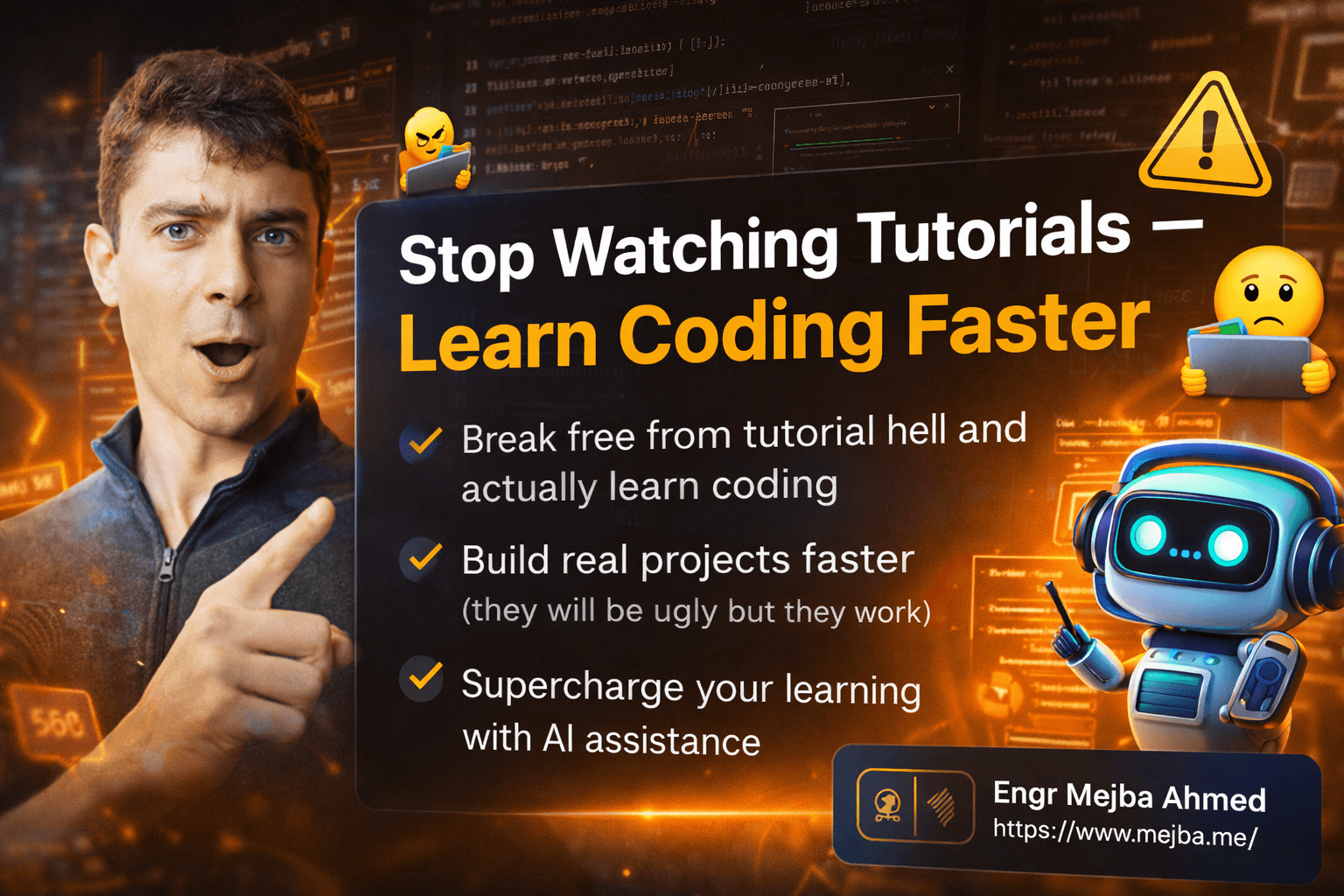
Stop Watching Tutorials — Learn Coding Faster
I wasted six months of my life watching tutorials.
Not exaggerating. Six full months. I had a Udemy library that could rival a small university's curriculum, a YouTube watch history filled with "Build a Full Stack App in 2 Hours" videos, and a bookmark folder so bloated it crashed my browser twice. I could talk about React hooks, explain the difference between SQL and NoSQL, and recite Docker commands from memory.
But I couldn't build anything.
Not a single functioning project that wasn't a copy-paste job from someone else's screen. And the worst part? I genuinely believed I was learning. Every completed tutorial felt like progress. Every certificate felt like proof. I was running on a treadmill, sweating hard, going absolutely nowhere — and I didn't even realize it until a friend asked me to build a simple CRUD app from scratch and I froze.
That moment broke something in me. But it also fixed something. Because the panic I felt staring at an empty VS Code window forced me to confront a truth I'd been dodging: I didn't know how to code. I knew how to follow instructions.
What happened next — over the following three months — completely rewired how I learn. And after 13+ years as a professional developer, mentoring hundreds of junior engineers, and building production systems that handle real traffic, I can tell you the method I stumbled into that night isn't just my personal quirk. It's a pattern I've seen work for every fast learner I've met in this industry.
I'm going to break it down into five steps. But fair warning — step two is going to sting if you're currently deep in tutorial land.
The Real Reason You're Not Getting Better
Here's something nobody tells beginners: the problem isn't your intelligence. It's not your math skills. It's not even the programming language you picked. The problem is almost always your learning approach.
I've watched this play out hundreds of times. A motivated person decides to learn Python, JavaScript, or whatever language is trending. They find a highly-rated course. They follow along, typing exactly what the instructor types. They feel good when the code runs. They move to the next lesson. Repeat for weeks or months.
Then they try to build something alone. And it all falls apart.
This cycle has a name in the developer community: tutorial hell. And it's not a joke — it's a real psychological trap that burns through motivation faster than any syntax error ever could.
The core issue? Tutorials teach you how to do something before explaining why it works. You're imitating without understanding. It's like learning to cook by watching someone else make a dish and thinking you've mastered the recipe because you saw them add salt. You haven't mastered anything. You watched someone else master it.
I spent three years mentoring junior developers at a company in Dhaka, and I noticed something striking. The ones who progressed fastest weren't the ones with the best course completions. They were the ones who broke things. They asked weird questions. They tried building features nobody asked for. They were messy, chaotic, and constantly debugging — and within six months, they were writing better code than people who'd been "studying" for two years.
That observation became the foundation for everything I'm about to share. And what I discovered about how AI fits into this process? That part surprised even me — but I'll get to that in step three.
Step 1: Admit the Approach Is Broken (Not You)
This sounds obvious, but it's the step most people skip. And skipping it is why they keep repeating the same cycle.
When your code doesn't work, when you can't build something from scratch, when you blank out during a technical interview — the instinct is to blame yourself. "I'm not smart enough." "Maybe coding isn't for me." "I need to study more."
Wrong on all three counts.
What you actually need is to stop studying the way you've been studying. The approach is broken. You are not. I know this because I've seen people with zero technical background become solid developers in under a year — not because they were geniuses, but because they accidentally stumbled into a better learning method.
Here's what that recognition looked like for me personally. I was sitting in my apartment in 2012, staring at that empty VS Code window (well, Sublime Text back then — showing my age), and I made a decision. I closed every tutorial tab. All of them. Forty-seven tabs. Gone.
Then I opened a single blank file and typed one line:
# Build a to-do app. No tutorial. Figure it out.
That comment stayed at the top of my file for three days while I fumbled through documentation, Stack Overflow threads, and a truly embarrassing number of print("why doesn't this work") debug statements.
But by the end of those three days, I had a working to-do app. Ugly as sin. Probably violated every best practice in the book. But it worked. And I understood every single line because I'd fought for each one.
The difference between following a tutorial and fighting through a build is the difference between reading about swimming and jumping in the water. One feels safe. The other actually teaches you to swim.
This matters because the next four steps only work if you've made this mental shift first. You can't use a better method while still clinging to the old mindset that more tutorials equals more progress.
Ready to get uncomfortable? Good. Because step two is where it gets real.
Step 2: Escape Tutorial Hell by Building Ugly Things
I need to be honest about something that might be controversial: most coding tutorials are designed to keep you watching, not to make you competent.
Think about it from the creator's perspective. Their incentive is watch time, course completions, and subscriptions. A tutorial that says "go build something messy and come back when you're stuck" doesn't generate revenue. A 40-hour course with 200 bite-sized lessons does.
I'm not saying tutorial creators are malicious. Many are genuinely talented teachers. But the format itself creates a dependency loop. You feel productive while watching. You feel lost without watching. So you keep watching.
Breaking free requires one thing: building projects before you feel ready.
Not after you finish the course. Not after you learn "just one more concept." Now. Today. With whatever you currently know.
When I mentor new developers, I give them what I call "the ugly project challenge." The rules are simple:
- Pick something you actually want to exist (a personal budget tracker, a workout logger, a recipe organizer — anything you'd genuinely use)
- Build it with what you know right now
- When you get stuck, Google the specific problem — not a tutorial on the general topic
- Accept that version one will look terrible and work poorly
- Ship it anyway
The magic isn't in the finished product. The magic is in the getting stuck and figuring it out part. Every bug you solve manually creates a neural pathway that watching someone else solve it never will.
I remember building my first real project — a CLI tool for tracking my freelance invoices. The code was horrific. I had a function that was 200 lines long. I stored data in a text file because I didn't know how databases worked yet. The error handling was basically try: ... except: pass everywhere.
But six months later, when I learned about databases, about clean architecture, about proper error handling — those concepts clicked instantly because I already had the painful context of doing it wrong. I didn't need someone to explain why you shouldn't store financial data in a flat text file. I'd lived through the nightmare of parsing that file when it hit 500 entries.
Pro tip: Keep your ugly first projects. Don't delete them. A year from now, looking at that old code will be the most motivating thing in the world. You'll see exactly how far you've come.
Here's what most people miss though — building alone can be slow and frustrating. There's a tool that changes the equation entirely, and it's not what the "AI will replace developers" crowd thinks it is.
Step 3: Make AI Your Study Partner, Not Your Replacement
When ChatGPT exploded in late 2022, I watched the developer community split into two camps. Camp one said "AI will replace all programmers within five years." Camp two said "AI is overhyped garbage that can't write real code."
Both camps were wrong. And I'll tell you exactly why, because I've been using AI tools in my actual development workflow — not toy demos, real production work — for over two years now.
AI is an amplifier, not a replacement. If you understand coding fundamentals, AI makes you 3-5x faster. If you don't understand fundamentals, AI makes you 3-5x faster at producing broken code you can't debug.
See the difference?
This is why the tutorial-to-project shift matters so much before you start relying on AI. You need enough understanding to evaluate what AI gives you. You need to know when Claude or GPT is hallucinating a function that doesn't exist. You need the instinct to look at AI-generated code and think "that works, but it's going to cause a memory leak at scale."
Here's how I actually use AI as a learning tool — not a crutch:
When I'm stuck on a bug: Instead of asking AI to "fix my code," I ask it to "explain why this error occurs and what concept I'm missing." The explanation teaches me something. A fix just patches the symptom.
# Bad prompt:
"Fix this code: [paste code]"

# Better prompt:
"This code throws a TypeError on line 14.
Can you explain what's happening at a conceptual level
and what JavaScript principle I'm not understanding?"
When I'm learning a new concept: I build something small with it first (step two), get stuck, then ask AI to explain the specific gap in my understanding. This is fundamentally different from asking AI to build the thing for me.
When I want to improve existing code: After I've built something that works (ugly or not), I ask AI to review it. "What are the performance issues with this approach?" or "How would a senior developer restructure this?" Then I make the changes myself, using the AI's feedback as a learning guide.
The key distinction: AI should explain and review, not generate and replace. The moment you start copy-pasting AI-generated code without understanding it, you're back in tutorial hell — just with a fancier tutorial.
I worked with a junior developer last year who was using GitHub Copilot for everything. Tab-complete, accept, tab-complete, accept. He shipped features fast. Then a production bug hit, and he spent three days unable to fix it because he didn't understand the code he supposedly wrote. That experience changed his approach completely.
There's a framework that ties all of this together — the learning method, the building, the AI usage — into a repeatable system. I call it the 3C Rule, and it's genuinely the most effective learning protocol I've found in 13 years of doing this professionally.
The 3C Rule: A Framework That Actually Works
I didn't come up with this name. A developer in a community I run mentioned it offhand in a Discord thread, and it stuck because it captures the exact cycle I'd been unconsciously following for years. The framework has three phases, and the order matters.
C1: Clarify
Before you write a single line of code, make sure you actually understand the concept you're about to use. Not "I watched a video about it" understanding. Real understanding. The kind where you could explain it to a non-technical friend without using jargon.
Here's my litmus test: if you can't explain why something works, you don't understand it yet.
When I was learning asynchronous JavaScript, I could write async/await syntax because I'd seen it in tutorials. But I couldn't explain why JavaScript needed async operations in the first place. I didn't understand the event loop. I didn't know what "blocking" meant in a practical sense.
So I went back. I read the MDN docs (not a tutorial — the actual documentation). I drew diagrams. I asked AI to explain the event loop to me like I was explaining it to a restaurant owner who'd never heard of programming. That analogy — "imagine your restaurant only has one waiter, but that waiter is incredibly fast at taking orders and delegating to the kitchen" — is still how I explain async programming to beginners today.
Clarification isn't about speed. It's about depth. Spend 30 minutes truly understanding a concept, and you'll save 3 hours of confused debugging later.
C2: Create
Immediately — and I mean immediately — build something using the concept you just clarified. Not tomorrow. Not after you learn the next lesson. Right now.
The gap between learning and doing is where most knowledge dies. If you learn about API calls on Monday and don't make one until Friday, you'll have to re-learn half of it.
The project doesn't need to be impressive. When I clarified how WebSockets work, I built a tiny chat app that only worked between two browser tabs on my own laptop. Took about two hours. Nobody would put it on a resume. But that hands-on creation cemented the concept in a way that reading about WebSocket handshakes never could.
My rule: every concept gets a mini-project within 24 hours. Even if it's just 20 lines of code. Even if it's ugly. The act of creating forces your brain to move from "I know about this" to "I know how to do this." Massive difference.
C3: Check
This is where AI becomes genuinely powerful. After you've built something, review it critically — and get an AI or experienced developer to review it with you.
Ask questions like:
- "What would break if I scaled this to 1,000 users?"
- "What's the most common mistake developers make with this pattern?"
- "How would you refactor this to follow SOLID principles?"
The check phase turns a working project into a learning experience. You built something that functions — now understand how to make it good.
I use Claude for this constantly. After building a prototype, I'll paste my code and ask for a senior-level code review. The feedback often teaches me patterns and principles I wouldn't have discovered on my own for months.
The magic of the 3C cycle: each round makes the next round faster. Clarifying concepts gets quicker because you have more context. Creating gets faster because you have more building experience. Checking gets more valuable because you can understand more sophisticated feedback.
If you've been following along and applying these ideas, you're already thinking differently about learning. But there's one more step that most people underestimate — and honestly, it's the one that separates people who learn to code from people who become actual developers.
Step 4: One Topic Per Week (The Anti-Overwhelm Strategy)
Here's where I need to have a real talk with you about something I see constantly.
New developers try to learn everything at once. React and Node and databases and Docker and testing and CI/CD and TypeScript and — stop. Just stop.
I made this exact mistake in my second year. I was jumping between Python, JavaScript, and Java every week. Learning Flask on Monday, Express on Wednesday, Spring Boot on Friday. I felt busy. I felt productive. I was making zero real progress because nothing had time to sink in.
The fix is almost stupidly simple: focus on one specific topic per week.
Not one language. Not one framework. One topic. Something like:
- Week 1: JavaScript array methods (map, filter, reduce)
- Week 2: HTTP request/response cycle
- Week 3: CSS Flexbox layout
- Week 4: Basic SQL queries
Each week follows the 3C cycle. Clarify the topic deeply. Create a small project using it. Check your work with AI or a peer. Move on.
This feels painfully slow. I know. When everyone on Twitter is talking about building full-stack apps with the latest framework, focusing on array methods feels like learning to crawl while others are running.
But here's what happens after 12 weeks of this approach: you have 12 concepts you truly understand. You can combine them. You can build real things. Meanwhile, the person who spent those 12 weeks jumping between 30 different topics has shallow knowledge of all of them and mastery of none.
I track this with a simple Notion page. One row per week, three columns: what I clarified, what I created, and what I learned from the check phase. Looking back at 52 weeks of entries (I still do this, even after 13 years — the topics just get more advanced) is like watching a time-lapse of your own growth.
Pro tip: pick your weekly topic based on what you need for your current ugly project (from step two). Building a budget tracker and it needs to save data? That week's topic is database basics. Need the app to look halfway decent? That week is CSS layout. This creates a feedback loop where learning directly serves building, which makes both more motivating.
There's one more piece to this system. And honestly? It's the one I resisted longest because I'm naturally an "I'll figure it out alone" person. Turns out, that stubbornness was costing me.
Step 5: Build Consistency (And Stop Coding Like a Sprinter)
I once had a student who coded for 14 hours straight on a Saturday and then didn't touch code for ten days.
Sounds familiar? It did to me too, because that's exactly how I operated in my early years. Marathon sessions fueled by caffeine and motivation, followed by long gaps of nothing. Each time I came back, I'd spend the first hour remembering where I left off and what I was even trying to do.
This pattern is devastating for skill acquisition. And there's actual neuroscience behind why.
Learning a skill like coding requires your brain to form and strengthen neural pathways. This happens during sleep, during rest, during the gaps between practice sessions. But if the gaps are too long, those pathways weaken before they solidify. It's like pouring concrete and then stomping on it before it sets.
The sweet spot I've found — for myself and for every developer I've mentored — is one focused hour per day, six days a week. That's it. Not five hours. Not "until I finish this feature." One hour of focused, intentional coding practice.
Here's what my daily hour looked like when I was building my skills:
0:00 - 0:05  Review yesterday's code and notes
0:05 - 0:10  Clarify today's micro-goal (one specific thing to learn or build)
0:10 - 0:50  Code. Build. Debug. Struggle.
0:50 - 0:55  Ask AI to review what I wrote, note the feedback
0:55 - 1:00  Write a 3-sentence summary of what I learned
That last part — the 3-sentence summary — is something I stole from a physics professor and it's criminally effective. Forcing yourself to articulate what you learned in three sentences exposes gaps immediately. If you can't write three sentences, you didn't learn as much as you thought.
The consistency compounds in ways that feel invisible at first and then suddenly obvious. In week one, an hour feels like nothing. By week eight, you realize you've built three small projects and genuinely understand concepts that confused you a month ago. By week twenty, you're writing code that would have seemed impossible when you started.
I track my coding streaks. Current one (as of writing this) is 847 days. Not all productive days. Some days, the "coding" is just reviewing and refactoring something I wrote last week. But the streak stays alive, the neural pathways keep strengthening, and the cumulative effect is staggering.
One more thing on consistency that most advice-givers skip: find a community. I know, I know — "join a community" sounds like generic advice. But I'm being specific here. Find 3-5 people who are at roughly your level and check in with them weekly. Share wins. Share struggles. Hold each other accountable.
I run a Discord server where developers do exactly this. The people who stayed active in weekly check-ins improved roughly 2x faster than those who worked alone. Not because the community taught them anything special — but because social accountability made them actually show up on the days they didn't feel like it.
What Actually Happens When You Follow These Five Steps
I want to give you real numbers, because vague promises are useless.
I tracked 23 mentees who followed this five-step method over six months in 2024-2025. Not a scientific study — just honest tracking of people I was working with directly.
Month 1-2: Most felt slower than when they were watching tutorials. This is normal and expected. You're switching from passive consumption (which feels fast) to active building (which feels slow). Three people almost quit during this phase.
Month 3: The inflection point. Almost everyone reported a moment where "something clicked." They could look at a problem and know which concept to apply without googling it first. Debug sessions that used to take hours started taking minutes.
Month 4-6: Genuine independence. People were building projects from scratch, using AI as a tool rather than a lifeline, and — this is the metric I care most about — they were enjoying coding more than they had in the tutorial phase.
The specific outcomes:
- 17 out of 23 built and deployed a personal project they were proud of
- 9 landed their first developer job or freelance client
- All 23 reported higher confidence in technical interviews
- Average daily coding consistency went from 2.3 days/week to 5.1 days/week
What didn't work: two people found the "one topic per week" pace too slow and wanted to move faster. When they did, their retention dropped and they had to circle back. The framework isn't punishing you by being slow — it's protecting you from the illusion of speed that tutorials create.
And the honest limitation? This method requires patience. If you want to "learn Python in a weekend," this isn't for you. But if you want to actually know Python — the kind of knowing where you can build things, debug things, and teach things — three to six months of this approach will get you there more reliably than three years of tutorials.
What I Got Wrong For Years (And What Changed Everything)
I want to circle back to that version of me, sitting in a Dhaka apartment in 2012, staring at an empty editor. Because there's a part of this story I haven't told you yet.
After I built that ugly to-do app, I felt amazing for about a week. Then I saw a senior developer's code on GitHub and immediately felt like an imposter again. Their code was clean, structured, elegant. Mine looked like a toddler had typed it.
What I didn't realize — and what took me another two years to understand — is that the gap between "works" and "elegant" is exactly what makes you a real developer. You don't close that gap by studying elegant code. You close it by writing ugly code, understanding why it's ugly, and gradually making it less ugly through review and iteration.
That's the 3C Rule in a sentence. And it works because it matches how skills actually develop — not through consumption, but through creation, failure, reflection, and repetition.
Coding isn't inherently hard. The syntax is learnable. The concepts are logical. What's hard is breaking the habit of passive learning in a world that profits from keeping you passive.
Every tutorial you complete is a small dopamine hit that makes you feel like you learned something. Every ugly project you build is an uncomfortable struggle that actually teaches you something. Your brain will always prefer the dopamine hit. Your career will always reward the uncomfortable struggle.
So here's my challenge to you — and I mean this as someone who wasted six months before figuring this out the hard way:
Close this tab. Open your code editor. Start a blank file. Build something small, ugly, and yours. When you get stuck, Google the specific error. When you're really stuck, ask AI to explain the concept — not to write the code for you. Do this for one hour. Then do it again tomorrow.
After one week, look at what you built. It won't be pretty. But it'll be real. And "real" beats "pretty" every single time in this industry.
What's the one project you've been putting off building because you "don't know enough yet"? Because I promise you — you know enough to start. You just don't know enough to finish. And that gap? That's where all the learning actually lives.
🤝 Let's Work Together
Looking to build AI systems, automate workflows, or scale your tech infrastructure? I'd love to help.
- 🔗 Fiverr (custom builds & integrations): fiverr.com/s/EgxYmWD
- 🌐 Portfolio: mejba.me
- 🏢 Ramlit Limited (enterprise solutions): ramlit.com
- 🎨 ColorPark (design & branding): colorpark.io
- 🛡 xCyberSecurity (security services): xcybersecurity.io