J'ai probablement livré une douzaine de sites avec Claude Code à ce stade. Des pages marketing, une landing page SaaS, quelques one-pagers pour des agences. Chacun était suffisamment abouti pour qu'un client paie volontiers plusieurs milliers d'euros. Et chacun avait le même défaut fatal dès que j'imaginais le livrer concrètement : le client ne pouvait pas changer un seul mot sans m'appeler.
C'est le secret que personne ne montre dans les vidéos de démo. Un CMS pour Claude Code n'est pas un ajout sympathique sur ces sites — c'est ce qui détermine si un magnifique site web généré par IA est un vrai produit ou une capture d'écran postée sur Twitter pour récolter des likes. Le problème de design a été résolu quelque part en 2025. Le problème du « et maintenant ? » ne l'a pas été.
Alors quand je suis tombé sur le tutoriel de Jack — c'est un entrepreneur en série dans le monde des startups IA — qui traitait exactement de cette lacune, j'ai prêté attention. Son constat était direct : environ 99 % des sites générés par Claude sont inutilisables en production parce qu'ils n'ont pas de couche de gestion de contenu. Un client qui doit corriger une coquille dans le titre principal a deux options : obtenir les identifiants bruts du dépôt (terrifiant) ou envoyer un message au développeur (un goulot d'étranglement qui tue vos marges). Aucune des deux ne passe à l'échelle au-delà d'une poignée de clients.
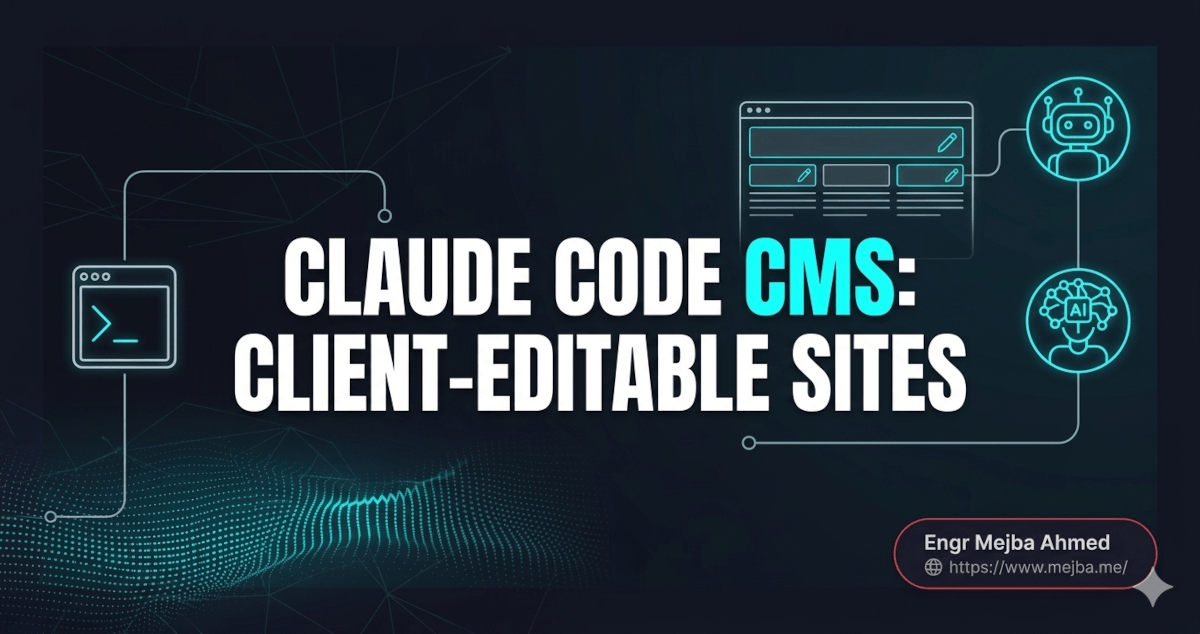
Sa solution est de construire un CMS par-dessus le site statique — une couche d'édition contrôlée qui permet aux non-techniciens de modifier le texte, remplacer les images, ajouter des pages et ajuster le SEO, sans jamais toucher au code ni pouvoir casser la mise en page. Je veux passer en revue comment ce stack s'assemble, ce qu'il coûte sur les offres gratuites, et — parce que j'ai utilisé chaque composant de ce stack en production — exactement où la réalité de la « version 1 » diverge de la bande-annonce. À la fin, vous saurez si ça vaut le coup de le construire pour votre propre travail client ou s'il vaut mieux prendre un outil clé en main.
Mais d'abord, la partie que la plupart des gens comprennent mal : pourquoi c'est important.
Pourquoi un magnifique site Claude Code ne vaut rien sans CMS
Voici une scène que j'ai vécue plus d'une fois. Vous livrez un site superbe. Le client est ravi. Deux semaines plus tard : « Salut, tu peux changer le numéro de téléphone dans le footer et mettre à jour les tarifs du deuxième palier ? Désolé de déranger ! »
Ce message vous coûte. Pas pour les cinq minutes que prend la modification — pour le changement de contexte, le redéploiement, le « tant que t'y es, tu pourrais aussi... » qui suit. Multipliez par dix clients et vous avez reconstruit exactement le piège du freelance dont j'ai parlé dans comment le clonage de sites web par IA génère des revenus récurrents : vous échangez du temps contre de l'argent sur un tapis roulant qui n'accélère jamais.
La réponse conventionnelle est « utilise WordPress » ou « construis-le sur Webflow ». Les deux fonctionnent. Les deux jettent aussi à la poubelle toute la raison pour laquelle vous avez utilisé Claude Code — le design sur-mesure, peaufiné à la main, qui ne ressemble pas à tous les autres templates d'internet. Dès que vous coulez un design généré par Claude dans un thème WordPress, vous avez poncé ce qui le rendait spécial.
Ce que l'approche de Jack préserve, c'est le code personnalisé et l'éditabilité. Le site reste un ensemble statique de fichiers ultra-rapides. Le CMS se place à côté comme un tableau de bord séparé qui sait quelles parties de la page sont modifiables et écrit les changements via un pipeline contrôlé. Le client obtient un identifiant qui n'expose que des cibles d'édition sûres — le texte du titre, le chiffre du prix, l'emplacement de l'image — jamais le HTML structurel qui maintient le design ensemble.
Jack appelle l'objectif « immuable face à la destruction par le client, mais toujours modifiable ». Cette phrase m'est restée parce qu'elle nomme l'exigence produit réelle. Les clients doivent pouvoir faire tout ce dont ils ont besoin et rien qui casse le site. C'est tout le jeu.
Et le mécanisme qui rend cela possible est un stack de quatre services gratuits ou quasi-gratuits reliés entre eux. Laissez-moi détailler chacun, car l'architecture est la partie intéressante — pas le marketing.
Le stack complet : Claude Code, GitHub, Vercel, MongoDB Atlas, OpenRouter
Retirez le pitch et le système se compose de cinq éléments, chacun ayant un rôle :
- Claude Code génère le site web et, séparément, le tableau de bord CMS lui-même.
- GitHub stocke le code source et vous donne le contrôle de version.
- Vercel déploie le site en production depuis GitHub et gère l'hébergement.
- MongoDB Atlas stocke tout le contenu modifiable comme source unique de vérité.
- OpenRouter achemine l'assistant d'édition IA vers le modèle de langage de votre choix.
Le flux fonctionne ainsi : Claude Code écrit le site et le pousse vers un dépôt GitHub privé. Vercel surveille ce dépôt et déploie tout ce qui est sur la branche principale vers une URL en production. Jusque-là, c'est un déploiement standard de site statique — rien de nouveau, et quelque chose que j'ai fait des dizaines de fois. Le CMS, c'est là que ça devient intéressant. Au lieu que le contenu soit codé en dur dans le HTML, les parties modifiables vivent comme des documents dans MongoDB. Le site publié lit depuis cette base de données (ou depuis un build qui en tire les données), donc quand un client modifie les tarifs dans le tableau de bord et clique sur publier, le changement se propage vers le site en production.
L'assistant d'édition IA — la fenêtre de chat qui permet à un client de dire « rends cette section plus courte et percutante » — fonctionne via OpenRouter. C'est un choix judicieux de la part de Jack, et voici pourquoi c'est important : OpenRouter est une API unique qui regroupe plus de 315 modèles d'Anthropic, OpenAI, Google, DeepSeek et d'autres, tous derrière un seul endpoint compatible OpenAI. Vous changez de modèle avec un seul paramètre, sans modification de code. Pour un CMS que vous vendez à des clients, cette flexibilité fait la différence entre être lié aux prix d'un seul fournisseur et pouvoir basculer vers un modèle moins cher dès qu'un nouveau sort.
Je suis honnête sur un point, parce que la démo le survole : connecter ces cinq éléments pour qu'ils restent synchronisés, ce sont les 20 % difficiles qui prennent 80 % du temps. Le discours « Claude le construit pour toi » est vrai pour le chemin idéal et optimiste partout ailleurs. Nous y reviendrons. D'abord, laissez-moi vous montrer ce que ça coûte à exploiter, car ce chiffre m'a surpris.
Combien coûte réellement l'exploitation de ce stack ?
Exploiter un CMS Claude Code pour un seul site client ne coûte effectivement rien sur les offres gratuites, plus une utilisation IA par édition mesurée en fractions de centime. Voici le détail vérifié en juin 2026.
Claude lui-même est le seul coût mensuel garanti. Le plan Pro coûte 20 $/mois (ou environ 17 $/mois en paiement annuel) et inclut désormais Claude sur le web, l'application de bureau, Cowork et Claude Code dans votre terminal. Un avertissement important que les vidéos omettent : le plan Pro fonctionne avec des fenêtres d'utilisation glissantes de cinq heures. Atteignez la limite à 14 h et votre prochaine fenêtre s'ouvre vers 19 h. Pour une génération intensive de sites, vous sentirez ce mur, et c'est la principale raison pour laquelle les gens passent au niveau Max.
GitHub est gratuit pour les dépôts privés. Aucun astérisque pour ce cas d'usage.
Le plan Hobby de Vercel est gratuit et généreux : 100 Go de bande passante, 1 million de requêtes edge et 1 million d'invocations de fonctions serverless par mois, avec 4 heures de CPU active. Le piège qui touche spécifiquement les agences — Hobby est uniquement pour un usage non commercial. Dès que vous hébergez le site d'un client payant, vous devriez être sur Pro à 20 $/mois par poste développeur, ce qui vous donne 1 To de bande passante et une facturation au dépassement au lieu d'un arrêt forcé. Pour les projets personnels, le gratuit convient parfaitement. Pour le travail client, budgétez les 20 $.
MongoDB Atlas propose un cluster gratuit M0 (anciennement appelé M0, maintenant simplement « Free ») avec 512 Mo de stockage. Pour une base de données de contenu stockant du texte, de la configuration de mise en page et un historique de versions, 512 Mo c'est beaucoup — des dizaines de sites y tiendront avant que ça ne compte. Les vraies contraintes sont les limites de débit : environ 100 opérations par seconde et 500 connexions simultanées. Parfait pour un CMS où les éditions sont des actions humaines occasionnelles. Pas du tout si vous pointez accidentellement le rendu de pages à fort trafic directement dessus sans cache.
OpenRouter est du pur paiement à l'usage sur les prix des modèles, avec une commission plateforme de 5,5 % sur les crédits. Pas d'abonnement. Si l'assistant d'édition IA d'un client exécute, disons, 50 demandes d'édition par mois contre un modèle de milieu de gamme, on parle de centimes. OpenRouter expose aussi des modèles gratuits (limités à environ 20 requêtes/minute, 200/jour) si vous voulez que l'assistant ne coûte littéralement rien pendant les tests.
Additionnez le tout pour un déploiement client réel : 20 $ Claude + 20 $ Vercel Pro + 0 $ GitHub + 0 $ MongoDB + quelques centimes d'OpenRouter = environ 40 $/mois pour exploiter un nombre illimité de sites clients via un seul tableau de bord. Si vous facturez aux clients 100–200 $/mois pour l'hébergement et les éditions — le modèle que j'ai détaillé dans l'article sur le modèle de rétention d'agence IA — la marge est évidente. C'est le levier de revenus récurrents caché dans un tutoriel CMS.
Maintenant la partie qui m'intéresse vraiment : comment construire la chose.
Comment construire un CMS sur un site web Claude Code ?
Vous construisez un CMS Claude Code en générant d'abord le site statique, en le déployant sur Vercel, puis en faisant générer par Claude Code une application de tableau de bord séparée qui se connecte à MongoDB Atlas pour le stockage du contenu et à OpenRouter pour l'assistant d'édition IA. Voici la séquence en cinq étapes que Jack démontre, avec mes notes sur chacune.
Étape 1 : Configurez Claude avec le bon plan
Installez l'application de bureau Claude et souscrivez au minimum au plan Pro (20 $/mois) pour avoir accès à Claude Code. Si vous comptez générer plusieurs sites dans une session, envisagez sérieusement Max — la fenêtre de cinq heures du Pro vous interrompra en pleine construction, et il n'y a rien de plus agaçant que d'attendre trois heures pour terminer une mise en page.
Étape 2 : Volez une direction de design (de la bonne façon)
C'est l'étape qui sépare un site qui ressemble à un site Claude d'un site qui ressemble au site de votre client. N'acceptez pas l'esthétique par défaut de Claude. Cherchez d'abord une vraie inspiration.
L'approche de Jack est de parcourir Dribbble, de trouver des mises en page qui correspondent à l'ambiance souhaitée par le client, et de fournir des captures d'écran ou des URL à Claude pour qu'il puisse analyser le langage visuel réel. Il utilise une skill « extracteur de blueprint de design » de sa communauté pour traduire cette inspiration en un plan de site structuré — système de couleurs, échelle typographique, organisation des sections, rythme d'espacement — avant qu'une seule ligne de code ne soit écrite.
Vous n'avez pas besoin de sa skill spécifique. C'est le principe qui compte : donnez à Claude une référence visuelle concrète plus une description claire de l'objectif et de la marque du site, et vous obtenez un résultat à des kilomètres du générique par défaut. J'ai trouvé la même chose à chaque fois — la qualité d'un design généré par Claude est presque entièrement fonction de la précision de la référence et du brief. Brief vague, site générique. Brief précis avec une vraie référence, quelque chose pour lequel un client paiera réellement. J'approfondis cette dynamique dans le guide des systèmes de design pour apps IA.
Dans la démo, le projet exemple est un site de services pour une entreprise d'automatisation IA vendant des agents « Hermes » qui réduisent les coûts opérationnels des entreprises. Claude a produit un thème professionnel cohérent, de vrais textes marketing, plusieurs illustrations personnalisées des concepts IA et une mise en page propre par sections — explications du système, logos de partenaires, le package complet. Les images personnalisées sont venues via une intégration API avec un générateur d'images IA abordable (il en utilise un appelé KIE) plutôt que des photos de stock, ce qui contribue largement à ce que le résultat ne ressemble pas à un template.
Étape 3 : Construisez et affinez itérativement
Générez, puis critiquez avec des captures d'écran. C'est non négociable. Vous donnez à Claude une capture de ce qu'il a produit et un retour détaillé — « l'espacement du hero est trop serré, la ligne des logos partenaires a besoin de plus d'espace, la couleur du CTA entre en concurrence avec le titre » — et il révise. Le premier jet n'est jamais le dernier. Traitez Claude comme un designer junior rapide que vous dirigez artistiquement, pas comme un distributeur automatique.
Étape 4 : Hébergez gratuitement
Claude Code gère cela presque entièrement via la CLI. Il crée un dépôt GitHub privé, pousse le code, connecte Vercel et déploie vers une URL en production. La seule chose que vous faites manuellement est l'authentification. GitHub est votre stockage de fichiers et contrôle de version ; Vercel reflète ce qui est dans le dépôt vers le site en production. Depuis le tableau de bord Vercel, vous pouvez aussi acheter ou lier un domaine personnalisé. J'ai exécuté ce flux de déploiement exact de nombreuses fois — c'est véritablement proche d'une seule commande une fois votre authentification en place, et c'est la partie la moins capricieuse de tout le système.
Étape 5 : Intégrez le CMS (la vraie partie difficile)
C'est ici que Claude génère une deuxième application — le tableau de bord CMS — et le connecte au site. Le tableau de bord se connecte à MongoDB Atlas (votre stockage de contenu), utilise un jeton Vercel pour déclencher les déploiements et route l'assistant d'édition IA via une clé API OpenRouter. C'est la pièce qui transforme un site statique en plateforme modifiable, et c'est la pièce qui demande un vrai travail pour bien fonctionner.
Si vous en êtes arrivé là et que vous acquiescez, vous réfléchissez déjà plus sérieusement à ce sujet que la plupart des gens qui regardent la démo et passent à autre chose. La section suivante est celle où je sépare ce qui fonctionne réellement de ce qui est encore brut.
Si vous préférez que quelqu'un construise et connecte tout ce stack pour vous — le site, le CMS, la configuration multi-tenant — j'accepte exactement ce type de missions. Vous pouvez voir ce que j'ai construit sur fiverr.com/s/EgxYmWD.
Configurer MongoDB Atlas comme backend de contenu
MongoDB est le bon choix pour cela, et ce n'est pas un hasard. C'est une base de données documentaire — elle stocke des documents de type JSON au lieu de lignes et colonnes rigides. Cela correspond presque parfaitement à un CMS, où chaque page est en réalité un arbre de blocs de contenu : un hero avec un titre et une image, une section de tarifs avec trois paliers, un footer avec les coordonnées. Vous stockez chaque page comme un document, chaque version comme un snapshot, et les requêtes sont rapides.
La mise en place du cluster gratuit est vraiment simple, et voici les étapes exactes de la démo, qui correspondent à ce que vous verrez dans l'interface Atlas aujourd'hui :
- Créez un compte MongoDB Atlas sur la console cloud.
- Choisissez le cluster gratuit M0 — 512 Mo de stockage, sans carte bancaire requise.
- Nommez le cluster quelque chose d'évident comme
website-cms. - Créez un utilisateur de base de données avec un nom d'utilisateur et un mot de passe avec lesquels le CMS s'authentifiera.
- Autorisez les adresses IP sous Accès réseau pour que votre app puisse se connecter. Pour le développement, vous pouvez autoriser toutes les IP temporairement, mais verrouillez cela avant la production.
- Récupérez la chaîne de connexion du driver et intégrez-la dans la configuration du CMS.
Une fois cette chaîne de connexion en place, le CMS cesse d'être un jouet local et devient quelque chose qu'un client peut atteindre via internet. Et voici le détail qui m'a réellement impressionné dans la démo : parce que MongoDB est la source unique de vérité, vous pouvez effacer entièrement le cache local et les fichiers et le CMS reconstruit son état à partir de la base de données. Le contenu n'est pas prisonnier du code. C'est une vraie victoire architecturale et exactement comment un système de contenu devrait se comporter — la base de données est le stockage canonique, le code est jetable.
Atlas vous offre aussi des sauvegardes automatiques, une distribution mondiale et un cluster géré toujours actif, donc vous ne babysittez pas un serveur de base de données. Pour un opérateur solo gérant des sites clients, « je n'ai jamais à penser à l'infrastructure de base de données » vaut beaucoup.
Une mise en garde honnête, car j'ai vécu ça : le plafond de ~100 ops/sec de l'offre gratuite M0 convient pour des éditions au rythme humain mais va absolument s'étouffer si vous l'architecturez mal — par exemple, en interrogeant la base de données à chaque vue de page publique au lieu de construire des pages statiques à partir d'elle. Lisez le contenu au build ou cachez agressivement. Ne laissez pas le trafic visiteur toucher M0 directement. Faites cette erreur et votre offre « gratuite » devient silencieusement la raison pour laquelle le site d'un client semble lent.
L'architecture à deux liens : comment fonctionne réellement le multi-tenant
C'est la partie de la construction de Jack que j'ai trouvée la plus ingénieuse, et aussi la partie où l'honnêteté « version 1 » compte le plus.
Le système utilise deux points d'entrée distincts :
- Un lien de contrôle maître pour vous, le développeur ou l'agence. De là, vous gérez chaque site client, choisissez quel modèle IA alimente les éditions et connectez les backends d'hébergement et de base de données. C'est votre centre de commande.
- Un lien d'édition côté client, protégé par mot de passe, limité au site d'un seul client. Le client se connecte et peut modifier son contenu et rien d'autre. Il ne peut pas voir les autres clients, ne peut pas toucher la structure, ne peut rien casser en dehors de son bac à sable.
Claude génère à la fois les sites clients individuels et le CMS maître, en coordonnant l'authentification pour que chaque utilisateur n'atteigne que ses pages assignées. Les jetons Vercel contrôlent le déploiement ; les clés OpenRouter contrôlent l'IA d'édition. En théorie, cela passe à l'échelle à des dizaines ou centaines de sites clients sous un seul tableau de bord, ce qui est le véritable levier commercial — c'est la même logique multi-tenant qui fait fonctionner le modèle de rétention d'agence IA à grande échelle.
Ce que le client peut faire dans son lien : modifier le texte et les prix, ajuster l'espacement et la mise en page dans des limites sûres, ajouter et modifier des images, ajouter de nouvelles pages (une page d'article, une page vierge, etc.), prévisualiser sur desktop/tablette/mobile avec des suggestions IA pour l'optimisation mobile, et utiliser des outils SEO qui évaluent les expressions cibles, suggèrent des améliorations et permettent de modifier les méta-descriptions par page. Il y a aussi une boîte de réception de formulaires qui capture les leads directement dans le CMS, et un assistant de chat IA intégré pour l'aide à l'édition. Chaque modification est versionnée, et seul le contenu validé est publié en production — ce qui protège la structure et le design contre la « destruction par le client ».
Maintenant l'honnêteté. Jack est franc sur le fait que c'est la version 1 et que c'est basique, et vous devriez le prendre au sérieux. Un CMS multi-tenant avec authentification, isolation des données par locataire, journaux d'audit, orchestration des déploiements et une couche d'édition IA est un vrai produit logiciel — le type de chose pour laquelle les entreprises lèvent des fonds. Claude Code peut assembler une version fonctionnelle impressionnamment vite, et la démo prouve que l'architecture est solide. Mais « la démo fonctionne de bout en bout » et « je confierais les données de cinquante clients payants et une vraie frontière d'authentification à cela » sont des affirmations différentes.
Les choses que je renforcerais personnellement avant de facturer quiconque : la frontière d'authentification et d'isolation des locataires (un bug ici signifie qu'un client voit les données d'un autre — inacceptable), la validation des entrées sur ce que l'éditeur IA est autorisé à écrire, et la limitation de débit pour qu'un seul client ne puisse pas épuiser vos crédits OpenRouter ou atteindre le plafond de débit M0 pour tout le monde. Rien de tout cela n'est une raison de ne pas construire. Ce sont des raisons de traiter la version 1 générée comme un solide point de départ, pas comme un produit fini que vous remettez à un client le premier jour.
Cette distinction — solide point de départ versus produit livrable — est tout l'intérêt d'être honnête sur le logiciel construit par IA. Alors laissez-moi prendre une position claire sur quand c'est la bonne décision.
Quand ce stack est le bon choix — et quand il ne l'est pas
Construisez le CMS Claude Code quand vous voulez un design entièrement personnalisé qu'aucun template ne peut offrir, que vous gérez vos propres projets ou un petit ensemble de sites clients, et que vous avez suffisamment de jugement d'ingénierie pour renforcer les frontières d'authentification et de données de la version 1 avant de passer en production. Le plafond de qualité du design et le coût d'hébergement quasi nul sont imbattables pour ce profil. C'est le bon choix pour un développeur-opérateur qui dirige une agence lean.
Optez pour un outil clé en main quand vous avez besoin d'une authentification multi-tenant éprouvée dès le premier jour, que vous n'êtes pas à l'aise pour examiner et renforcer du code backend généré, ou que vos clients ont besoin de fonctionnalités (e-commerce, permissions complexes, pistes d'audit de conformité) qu'une v1 n'aura pas. Un CMS headless mature ou un plan Webflow existe pour une raison. Il n'y a aucune honte à ne pas réinventer l'authentification.
L'erreur contre laquelle je mettrais en garde — et j'ai vu des gens la commettre — est de traiter la démo léchée comme prête pour la production et de sauter le renforcement. Un logiciel généré par IA semble fini parce qu'il fonctionne. Fonctionner et être sûr à mettre devant des clients payants ne sont pas la même chose. J'ai fait des versions de cette erreur moi-même, livrant quelque chose qui marchait dans la démo et qui cassait dès que des données réelles le touchaient. La solution est ennuyeuse : examinez le code généré, testez la frontière d'authentification comme le ferait un attaquant, et cachez agressivement pour que vos offres gratuites ne vous trahissent pas sous charge.
Voici la prédiction que je suis prêt à faire. D'ici un an, « l'IA construit votre site et donne à votre client un moyen sûr de le modifier » cessera d'être un tutoriel astucieux et deviendra un prérequis pour quiconque vend du travail web généré par IA. Le problème de design est résolu. Le problème d'éditabilité est le nouveau fossé. Celui qui perfectionne la couche d'édition contrôlée — immuable face à la destruction par le client, mais entièrement modifiable — possède les revenus récurrents. Les outils montrés ici sont une ébauche précoce et honnête de la direction que cela prend.
Questions fréquentes
Claude Code peut-il construire un CMS ?
Oui — Claude Code peut générer à la fois un site web statique et un tableau de bord CMS séparé qui se connecte à une base de données, déploie via Vercel et utilise un assistant d'édition IA. Le CMS généré est une solide version 1 fonctionnelle qui nécessite un renforcement de l'authentification et de l'isolation des données avant de le confier à des clients payants. Voir les étapes de construction ci-dessus pour la séquence complète.
Quelle est la façon la moins chère d'héberger un site web Claude Code ?
Le chemin le moins cher prêt pour la production est GitHub pour le dépôt (gratuit), Vercel Pro pour l'hébergement commercial (20 $/mois), et le cluster gratuit M0 de MongoDB Atlas (512 Mo) pour le contenu. Le plan gratuit Hobby de Vercel ne fonctionne que pour les sites personnels non commerciaux.
L'offre gratuite de MongoDB Atlas suffit-elle pour un CMS de site web ?
Pour un CMS de contenu, oui — les 512 Mo de stockage du cluster gratuit M0 contiennent facilement du texte, de la configuration de mise en page et un historique de versions pour de nombreux sites. La vraie limite est le débit (~100 opérations par seconde), donc cachez agressivement et ne pointez jamais le rendu de pages publiques directement sur M0 sous trafic.
Que fait OpenRouter dans cette configuration ?
OpenRouter est l'API unique qui alimente l'assistant d'édition IA du CMS, proposant plus de 300 modèles d'Anthropic, OpenAI, Google et d'autres derrière un seul endpoint compatible OpenAI. Vous changez de modèle avec un paramètre, et les prix sont transparents plus une commission plateforme de 5,5 % — pas d'abonnement. Cette flexibilité vous protège d'être lié aux coûts d'un seul fournisseur.
Pourquoi les clients ne peuvent-ils pas simplement modifier un site Claude Code directement ?
Parce que le design vit dans du code personnalisé, et donner à un client non technique un accès brut au dépôt signifie qu'une mauvaise modification casse la mise en page. Une couche CMS n'expose que des cibles d'édition sûres — texte, prix, images, balises meta — tout en gardant le code structurel verrouillé, pour que les clients puissent changer tout ce dont ils ont besoin et rien de ce qu'ils ne devraient pas.
Travaillons ensemble
Vous cherchez à construire des systèmes IA, automatiser des workflows ou faire évoluer votre infrastructure technologique ? Je serais ravi de vous aider.
- Fiverr (builds et intégrations sur mesure) : fiverr.com/s/EgxYmWD
- Portfolio : mejba.me
- Ramlit Limited (solutions entreprise) : ramlit.com
- ColorPark (design et branding) : colorpark.io
- xCyberSecurity (services de sécurité) : xcybersecurity.io