On August 16, DeepSeek changed something more important than a benchmark.
It changed the clock.
The same API could now cost you a different amount depending on when you called it.
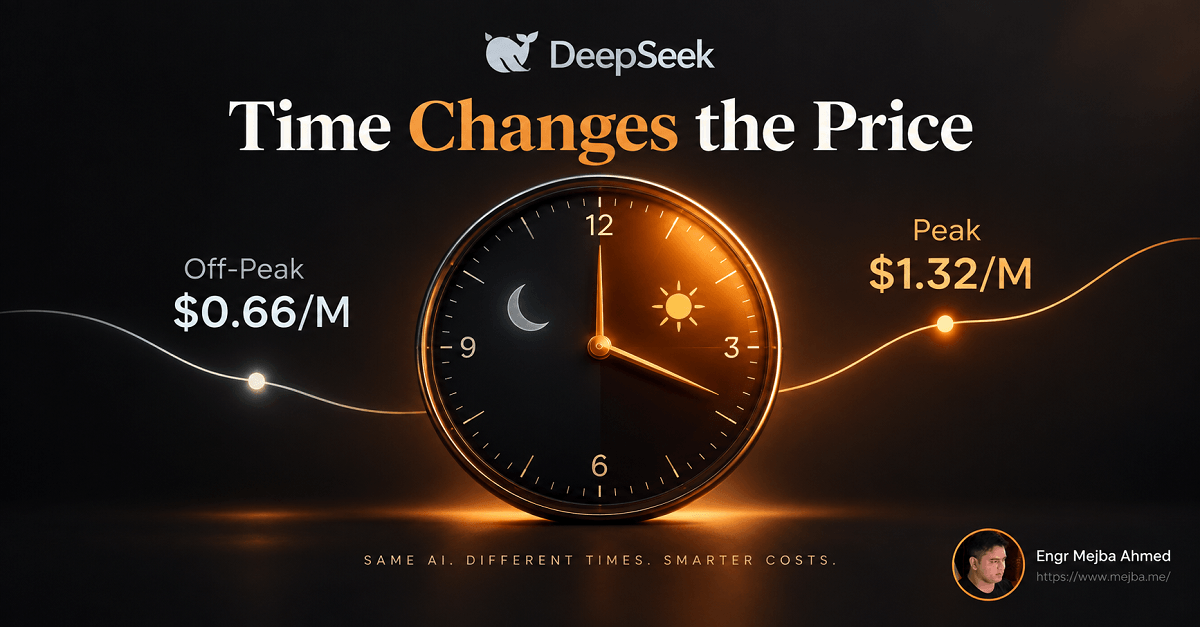
For DeepSeek V4-Flash, output moved from a flat $0.28 per million tokens to:
- $1.32/M during peak hours
- $0.66/M off-peak
V4-Pro moved to:
- $3.96/M peak
- $1.98/M off-peak
DeepSeek described the change as a way to allocate compute resources more efficiently and encourage users to move flexible workloads outside busy periods.
That pricing change is the cleanest way to understand the middle of August 2026.
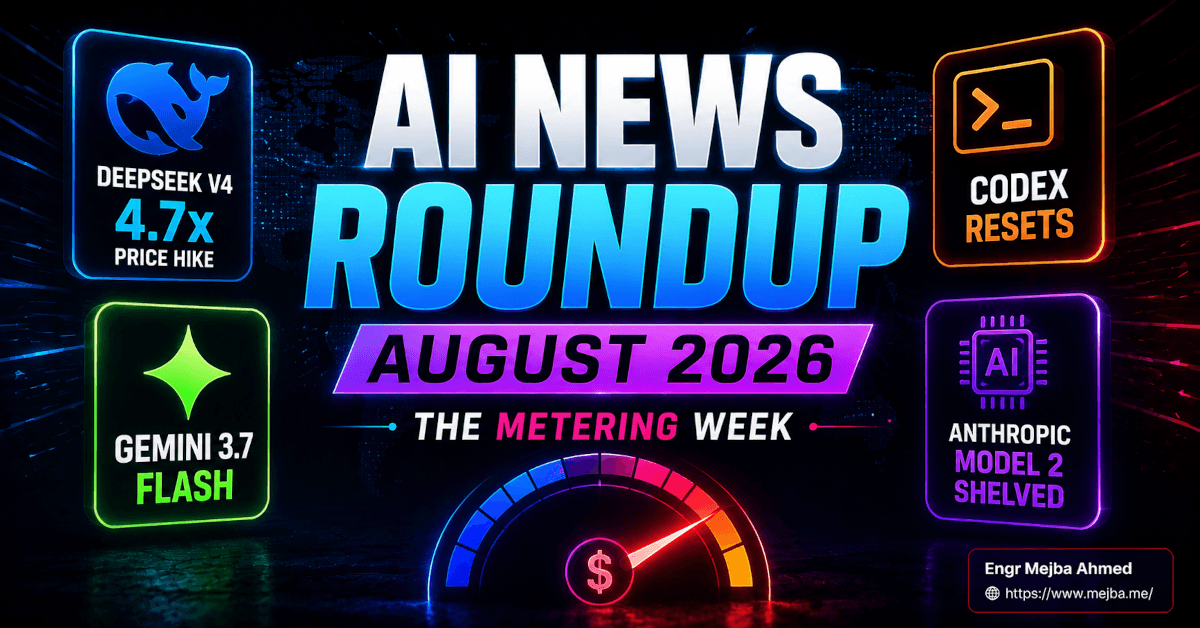
The week's AI news looked like a collection of unrelated launches:
- DeepSeek repriced V4 around demand.
- Google launched Gemini 3.7 Flash at an introductory rate scheduled to double in January.
- NVIDIA released a small-active-parameter open model aimed at the high-volume execution layer of agents.
- OpenAI kept experimenting with Codex usage resets.
- Anthropic disclosed an internal model it was using heavily but was not planning to release.
- Anthropic also explained how text watermarking would work under new EU transparency requirements.
Underneath all of them was the same constraint:
AI capability keeps improving, but somebody still has to allocate the compute.
This was the week the allocation mechanisms became visible.
Update — September 13, 2026: Several August conditions have already changed. DeepSeek released V4.1-Flash on September 10 with lower pricing and is phasing out V4-Pro beginning September 14. OpenAI now officially supports purchased instant Codex resets for some eligible Plus and Pro users. The August sections below are therefore preserved as a snapshot of the decisions available at the time, with current changes called out where they affect the conclusion.
The Week in One Table

| Date | Company | What changed | Why it mattered economically |
|---|---|---|---|
| Aug. 11 | NVIDIA | Nemotron 3.5 Lightning | Gives agent builders an open 30B/3B-active execution model |
| Aug. 13 | Gemini 3.7 Flash | Introductory API pricing through Dec. 31 | |
| Aug. 14 | Anthropic | August Risk Report | Shows frontier capability being used internally rather than automatically released |
| Aug. 14 | Anthropic | Text-watermark explanation | Adds provenance as another constraint on generated content |
| Mid-August | OpenAI | Promotional Codex resets | Makes usage allowance itself part of product behavior |
| Aug. 16 | DeepSeek | V4 peak/off-peak pricing | Makes time of day an API-cost variable |
This is why I call it the metering week.
Different companies metered different things:
DeepSeek: time.
Google: introductory pricing window.
OpenAI: usage allowance.
NVIDIA: local hardware instead of token rental.
Anthropic: external access to its frontier capability.
Not all of those are literal billing meters.
They are all allocation mechanisms.
DeepSeek Made Time of Day Part of the API Architecture
The August DeepSeek change was more interesting than simply saying:
DeepSeek got more expensive.
It created two classes of workload.
Interactive Workloads
A user is waiting.
Examples:
- chat;
- coding assistance;
- customer support;
- live agents;
- synchronous API requests.
You cannot simply move these calls to 3 a.m. because the user happened to arrive at 2 p.m.
Flexible Workloads
Nobody is waiting.
Examples:
- overnight summarization;
- evaluation runs;
- enrichment pipelines;
- report generation;
- dataset processing;
- scheduled content jobs.
These can be moved.
That means pricing policy became an architectural variable.
The August V4 pricing was:
| Model | Input cache miss | Output |
|---|---|---|
| V4-Flash off-peak | $0.22/M | $0.66/M |
| V4-Flash peak | $0.44/M | $1.32/M |
| V4-Pro off-peak | $0.66/M | $1.98/M |
| V4-Pro peak | $1.32/M | $3.96/M |
DeepSeek's current documentation still uses peak/off-peak billing, although the model lineup and rates have since changed.
The Dhaka Problem: Global Pricing Is Not Experienced Globally
DeepSeek's peak windows were defined in UTC.
That means the same pricing policy affects teams differently depending on where their users live.
For a team in Bangladesh, the August peak periods landed directly inside parts of the local working day.
For a U.S. team, much of the same UTC period could occur during overnight or early-morning hours.
That creates an unusual kind of regional cost difference.
The list price is identical.
The experienced price is not.
This is a useful reminder for any time-based cloud service:
Never evaluate a UTC pricing schedule before converting it into the hours when your own workload actually runs.
It sounds obvious.
It is surprisingly easy to miss when the provider's pricing page is denominated in dollars rather than local business hours.
One Correction to My Original Off-Peak Math
My first draft said 70.8% of the entire clock was off-peak.
That was based on seven peak hours out of every 24.
Current DeepSeek documentation specifies those peak windows as applying Monday through Friday.
Under that current schedule:
- weekdays contain 7 peak hours each;
- weekends are entirely off-peak;
- 35 of 168 hours in a week are peak.
So roughly 79.2% of the full week is off-peak under the current rule.
The practical lesson stays the same.
If your workloads are schedulable, there is substantial cheap capacity available.
But the arithmetic should match the provider's actual schedule.
DeepSeek's August Pricing Is Already Historical
This is why AI pricing articles age so quickly.
On September 10, DeepSeek introduced V4.1-Flash with lower API pricing.
DeepSeek also announced that beginning September 14, V4-Pro requests would route to V4.1-Flash while the company works toward V4.1-Pro.
So I would no longer architect a new system around the August V4-Pro rate table.
The useful part of the August story is the pricing mechanism:
DeepSeek kept peak/off-peak billing.
The exact model at the endpoint changed.
That distinction matters when writing evergreen analysis.
Model prices expire.
Architecture patterns last longer.
Gemini 3.7 Flash Was the Opposite Pricing Strategy
Google launched Gemini 3.7 Flash on August 13, 2026, three weeks after Gemini 3.6 Flash.
Its introductory API price is:
- $0.75/M input
- $3.75/M output
through December 31, 2026.
On January 1, 2027, those rates are scheduled to become:
- $1.50/M input
- $7.50/M output
Google says the introductory rate is half the model's eventual standard price.
DeepSeek discounted by time of day.
Google discounted by calendar window.
The pricing question becomes:
What happens to my architecture when the promotion expires?
That should be answered before migrating a large pipeline, not on January 2 after the invoice arrives.
Gemini 3.7 Flash Improved Most Where Agents Need It
Google's own benchmarks show sizeable jumps over Gemini 3.6 Flash.
| Benchmark | Gemini 3.6 Flash | Gemini 3.7 Flash |
|---|---|---|
| DeepSWE v1.1 | 48.6% | 65.3% |
| FrontierCode 1.1 | 34.4% | 43.6% |
| AutomationBench | 17.0% | 30.4% |
| WebDev Arena | 1538 Elo | 1588 Elo |
| Terminal-Bench 2.1 | 78.0% | 85.8% |
Google's launch blog rounds the older DeepSWE score to 49.0%, while its model card reports 48.6%; the new 65.3% result is consistent across both.
The AutomationBench number is a good example of how to read AI benchmarks properly.
Going from:
17.0% → 30.4%
is an enormous relative improvement.
It also means the model does not complete almost seven out of ten tasks in that evaluation.
Both statements matter.
"Nearly doubled" sounds impressive.
"30.4% pass rate" tells you whether you should remove human verification.
You should not.
The More Interesting Gemini Number Is Cost per Useful Task
A token price is not a productivity metric.
Suppose Model A costs half as much per token but requires:
- more retries;
- longer prompts;
- larger outputs;
- additional verification;
- human correction.
Model B can still be cheaper per completed job.
This is particularly important for agentic workloads because they repeatedly loop:
reason
→ call tool
→ inspect result
→ reason
→ call another tool
→ recover from failure
→ continue
A small improvement in task success can remove entire turns.
That is why I now track:
cost per accepted result
rather than only:
cost per million tokens.
The August pricing wave reinforced that lesson.
NVIDIA Took a Different Route: Stop Renting Every Token
On August 11, NVIDIA released Nemotron 3.5 Lightning.
The model has:
- 30B total parameters
- roughly 3B active parameters per forward pass
- a hybrid Mamba/Transformer/MoE architecture
- up to a 1M-token context
- open weights
- BF16 and NVFP4 variants.
NVIDIA explicitly positions it for long-running agents, subagent workloads, and high-volume execution.
The key phrase is not "30 billion parameters."
It is:
3 billion active.
The system carries broader capacity while routing each token through only part of the model.
That makes it interesting for work where you do not need frontier reasoning on every turn.
Agent Systems Probably Need Two Intelligence Tiers
A useful agent architecture increasingly looks like this:
          Hard reasoning
               ↓
        Frontier model
               ↓
   planning / difficult decisions

--------------------------------

      High-volume execution
               ↓
      Small/open model
               ↓
routing
validation
retrieval
classification
summarization
log triage
routine tool use
This makes more sense to me than sending every operation to the most capable model you can afford.
Consider:
Did the API response conform to this JSON schema?
You probably do not need the world's strongest model.
Or:
Summarize these five build logs.
Again, probably not frontier work.
But:
Diagnose why this distributed migration fails only under concurrent writes and propose a safe rollout.
That may deserve substantially more intelligence.
The optimization is not:
small model everywhere.
It is:
spend expensive intelligence only where expensive intelligence changes the outcome.
Nemotron 3.5 Lightning Was Built for That Execution Layer
NVIDIA says the model can deliver up to 4× output throughput versus comparable models under its tested setups, and reports a 30% faster completion time than Qwen3.6 35B on a 10,000-task PinchBench run at similar accuracy.
Those are NVIDIA's measurements, not universal deployment guarantees.
Hardware, quantization, runtime and batch shape all matter.
Still, the product direction is clear.
NVIDIA is not pitching Lightning as:
replace every frontier model.
It is pitching it as a fast execution model inside larger agent systems.
That makes much more sense.
Self-Hosting Is Not Automatically Cheaper
The original draft tried to establish a single GPU break-even point.
I would remove that number.
Cloud GPU prices vary too much across:
- providers;
- regions;
- reserved vs on-demand pricing;
- utilization;
- GPU generation;
- batching;
- quantization;
- workload concurrency;
- networking;
- engineering overhead.
The right comparison is:
monthly API spend
vs.

GPU cost
+ idle capacity
+ serving infrastructure
+ monitoring
+ engineering time
+ failure recovery
If your local model server sits at 8% utilization, you are paying for a very expensive heater.
If you have a continuous agent fleet keeping it busy, the economics change.
So I would benchmark the actual workload before deciding that "open model" means "cheaper model."
Open means you gain another option.
It does not remove arithmetic.
Anthropic's Model 2 Was a Different Kind of Allocation Decision
Anthropic's August 14 Risk Report disclosed an internal unreleased model referred to as Model 2.
Anthropic says the report covers company risks through a July 15 cutoff under its Responsible Scaling Policy.
The most discussed number was CoBench v2.
Reported results include:
- Model 2: 62.8%
- Mythos 5: 50.3%
- Mythos Preview: 54.8%
Anthropic's report nevertheless describes Model 2 overall as only somewhat stronger than Mythos 5, rather than a uniform capability jump across every domain. Model 2 had also not completed the company's full predeployment assessment suite.
That is important.
A 12.5-point gain on one benchmark does not mean:
Model 2 is 25% smarter.
It means:
Model 2 performed substantially better on this particular evaluation.
Benchmark specificity matters.
Why Model 2 Was More Interesting Than Another Model Launch
There was no API migration to plan.
No new model string.
No pricing table.
That is precisely why the disclosure matters.
Anthropic said Model 2 and its top systems were already being used extensively for internal research and engineering, including software work and data generation.
The strongest model does not necessarily maximize value when rented to external developers.
It may produce more value helping the lab:
- write internal software;
- run experiments;
- generate training data;
- accelerate future model development.
That is a compute-allocation decision.
Which brings it back into the week's theme.
DeepSeek allocates scarce serving capacity through time-based pricing.
Google allocates adoption through promotional pricing.
Anthropic can allocate frontier compute inward rather than exposing every capability externally.
Different mechanism.
Same scarce resource.
The Risk Report Also Warned That Measurement Is Getting Harder
One of the more important parts of Anthropic's August report was not Model 2's headline benchmark.
It was uncertainty.
Anthropic raised its catastrophic misalignment risk assessment from very low to low and acknowledged limitations in its ability to measure increasingly capable systems with existing evaluations.
That deserves a careful interpretation.
It does not mean:
Anthropic has evidence its models are catastrophically misaligned.
It means the company's own assessed risk increased and some evaluation methods are providing less certainty as systems improve.
Those are different claims.
Safety evaluation has the same benchmarking problem as product evaluation:
a ruler that worked at one capability level may not remain useful forever.
Anthropic's Watermark Story Needed a Major Correction
The original draft said:
Effective August 2, Claude models watermark everything they generate.
That is not accurate.
August 2 is tied to the EU AI Act transparency requirement.
On August 14, Anthropic explained how its text-watermark system works and said future Claude models would produce watermarked text. Models released before August 2 receive a transition period and are being updated over time.
That distinction matters.
The implementation is model-dependent, not an instantaneous universal switch across every historical Claude model.
How Claude's Text Watermark Works
Anthropic's system does not add:
- invisible Unicode;
- zero-width characters;
- hidden metadata;
- extra tokens.
Instead, it statistically influences low-stakes word choices in a pattern that can later be tested using a secret key controlled by Anthropic.
That means the watermark is probabilistic.
It is not a serial number.
And Anthropic explicitly says it carries no:
- user ID;
- organization identity;
- conversation identifier.
Most importantly:
it does not establish authorship.
Anthropic says a watermark indicates that Claude may have produced or processed the text.
If I write an article myself and ask Claude to tighten the language, that processed result may carry the signal.
That does not make Claude the author of the idea.
This distinction matters for:
- universities;
- publishers;
- employers;
- client contracts;
- compliance systems.
A watermark detector should not be treated as an authorship detector.
Codex Resets Turned Usage Allowance Into a Product Surface
OpenAI also spent August experimenting visibly with usage resets for Codex and ChatGPT Work.
Codex team announcements around user milestones triggered global or banked usage resets for paid users, and OpenAI's support documentation now formally distinguishes:
- automatic/global resets;
- banked resets;
- purchased resets;
- normal usage-window resets.
That distinction did not exist clearly enough in my original draft.
A banked reset can sit in the account until used or expired according to the offer.
An automatic reset applies immediately.
A purchased instant reset is now officially available to some eligible Plus and Pro accounts, depending on account and billing country.
The August "Paid Reset" Rumor Was Half Right for the Wrong Reason
During August, specific unverified price ranges circulated for future Codex resets.
I would not publish those numbers.
They were not in official OpenAI documentation.
And at the time, OpenAI support explicitly said banked resets themselves were promotional rather than directly purchasable.
Since then, OpenAI has introduced purchased instant resets for eligible users.
So the broad prediction—
usage resets may become monetized
—turned out to point in the right direction.
The circulated August price list was still unsupported.
That distinction is exactly why rumor sections need dates and labels.
A prediction becoming partly true later does not retroactively make unsupported numbers factual.
A Reset Also Changes Your Usage Window
This matters if you actually rely on one.
Current OpenAI documentation says applying a full banked or purchased reset refreshes relevant Codex usage windows and can move the weekly reset date.
A reset is therefore not simply:
free extra capacity layered on top of the existing schedule.
It can restart the schedule itself.
If you are coordinating heavy Codex usage across a week, that behavior belongs in the planning model.
Again:
metering becomes workflow architecture.
The Strongest Thesis From This Week Is Model Routing

After stripping out the launch-day noise, the week's most useful architecture lesson is this:
Do not route every task to one model.
The provider landscape itself is telling you to stop doing that.
Use frontier models for:
- difficult reasoning;
- architecture;
- ambiguous debugging;
- research synthesis;
- high-value decisions.
Use faster models for:
- routine agent turns;
- ordinary coding;
- transformation;
- lower-risk tool use.
Use open/local models for:
- repetitive internal routing;
- classification;
- schema checking;
- summarization;
- log triage;
- high-volume work where data locality matters.
Use scheduling for:
- batch work;
- evals;
- offline enrichment;
- asynchronous pipelines.
Use Batch or discounted execution where available.
The largest cost optimization is often not a 10% lower price.
It is avoiding expensive inference altogether when the task does not need it.
The Metric I Would Track: Cost per Completed Job
Imagine two models.
Model A
- $1/M input
- $5/M output
- succeeds 60% of the time
Model B
- $2/M input
- $10/M output
- succeeds 95% of the time
The rate card says Model A is half the price.
Your workflow may say something very different after:
- retries;
- failed tool calls;
- verification;
- human correction;
- latency;
- downstream errors.
That is why agent teams should measure:
- cost per task;
- retries per task;
- latency to acceptance;
- human correction time;
- success rate;
- cache hit rate;
- output-token volume.
Those numbers tell you where to route.
A pricing page cannot.
What I Would Change in an Agent Stack After This Week
I would make five concrete changes.
1. Separate Interactive and Batch Work
If a task can run later, label it explicitly.
Do not let an architecture accidentally make every request latency-sensitive.
That gives you access to:
- off-peak pricing;
- batch discounts;
- idle compute;
- cheaper queues.
2. Route by Difficulty
Use a fast default.
Escalate only when:
- the model fails;
- the task is inherently hard;
- verification says the cheaper path is unreliable.
3. Move Repetitive Plumbing Off Frontier Models
Schema validation does not usually need frontier intelligence.
Neither does every classification decision.
If you have enough volume, test open models.
4. Put Promotional Expiry Dates in the Architecture Calendar
Gemini 3.7 Flash doubles in price on January 1, 2027 under Google's current schedule.
That means December is not just a billing date.
It is a re-evaluation date.
Any temporary price belongs in your architecture documentation with its expiration date.
5. Re-Benchmark Provider Changes Instead of Assuming Yesterday's Winner Still Wins
This article itself demonstrates the problem.
DeepSeek's August model comparison was outdated less than a month later because V4.1 arrived.
Do not hard-code model economics into a permanent architectural belief.
Re-run the table.
What Changed Since the Original August Draft?
Because this is now September 13, several developments change how I would read the original story.
DeepSeek
V4.1-Flash is now live with a more efficient architecture and lower pricing.
DeepSeek is phasing out V4-Pro beginning September 14.
Codex
Purchased instant resets are now officially documented for some eligible Plus and Pro users.
The rumor that usage allowances would eventually become directly purchasable was directionally correct, although the August price ranges remain unverified.
Claude Watermarking
The system is clearer now.
Anthropic's newer models carry the watermark, while older pre-August-2 models have a transition period.
It was never accurate to say all Claude output globally became watermarked on August 2.
Nemotron
The model's role has become even clearer in NVIDIA's own documentation: it is designed as the high-volume execution layer of long-running agents, not simply another small chatbot.
The metering thesis therefore holds up.
Some of the original facts did not.
FAQ
Frequently Asked Questions
Everything you need to know about this topic
Under the August V4 pricing change, V4-Flash output went from $0.28/M to $1.32/M at peak and $0.66/M off-peak. V4-Pro output was $3.96/M peak and $1.98/M off-peak.
Those exact rates should now be treated as historical because DeepSeek released V4.1-Flash with new pricing on September 10.
Current DeepSeek documentation lists:
01:00–04:00 UTC and 06:00–10:00 UTC
Monday through Friday.
All other periods are off-peak.
Through December 31, 2026:
Beginning January 1, 2027:
Google's published evaluations show significant gains on several coding and agentic benchmarks, including DeepSWE, FrontierCode and AutomationBench.
That does not guarantee the same improvement on your workload, so benchmark representative tasks before migrating production traffic.
It is an open 30B-parameter mixture-of-experts model with roughly 3B active parameters per forward pass and up to a 1M-token context.
NVIDIA positions it for long-running agents, subagent tasks and other high-volume execution workloads.
Model 2 is an unreleased internal Anthropic model disclosed in its August 2026 Risk Report.
It scored 62.8% on CoBench v2 compared with 50.3% for Mythos 5, but Anthropic had not completed its full normal predeployment assessment process and had no announced plan to release it publicly.
Not exactly.
Anthropic says newer Claude models are being released with its statistical text watermark to meet AI-transparency requirements. Models released before August 2 have a transition period.
The watermark indicates possible Claude processing, not authorship or user identity.
As of September 2026, OpenAI says purchased instant resets are available to some eligible personal Plus and Pro accounts, depending on account and billing country.
Banked promotional resets and purchased resets are separate mechanisms.
The Bottom Line
The interesting thing about August 2026 was not that AI suddenly became more expensive.
Some models became cheaper.
Some became faster.
Some could be run locally.
Some frontier capability was not released at all.
The deeper shift was that compute allocation became part of the product design.
DeepSeek charged according to time.
Google discounted according to calendar.
OpenAI experimented with usage-reset mechanisms.
NVIDIA gave developers an alternative to renting every low-value inference call.
Anthropic demonstrated that a frontier model may be worth more to the lab internally than it is as another public API SKU.
That should change how we build agent systems.
The question is no longer:
Which model is best?
It is:
Which model deserves this particular call, at this particular time, under this particular pricing mechanism?
The best architecture probably does not have one answer.
It has a router.
And the router should optimize for something much more useful than price per million tokens:
cost per successfully completed job.
That is the real lesson from the metering week.
Let's Work Together
Looking to build AI systems, automate workflows, or scale your tech infrastructure? I'd love to help.
- Fiverr (custom builds & integrations): fiverr.com/s/EgxYmWD
- Portfolio: mejba.me
- Ramlit Limited (enterprise solutions): ramlit.com
- ColorPark (design & branding): colorpark.io
- xCyberSecurity (security services): xcybersecurity.io